

Preventing serious effects of skin cancer is where one of the most effective tools is the early detection. Though some individuals use occasional visual examinations on their skins, current-day medicine enables physicians to examine the skin chronologically instead of evaluating it on a single occasion. At this point, skin mapping around me will become a critical component of long-term skin health.
The rate of skin cancer in Australia is one of the highest in the world. Prolonged exposure to high ultraviolet radiation, outdoor activities, and cumulative sun damage are all risk factors, which may not manifest themselves. Most hazardous skin cancers are painless, itch-free and bloody. When a visible change is observed, the disease may be very advanced.
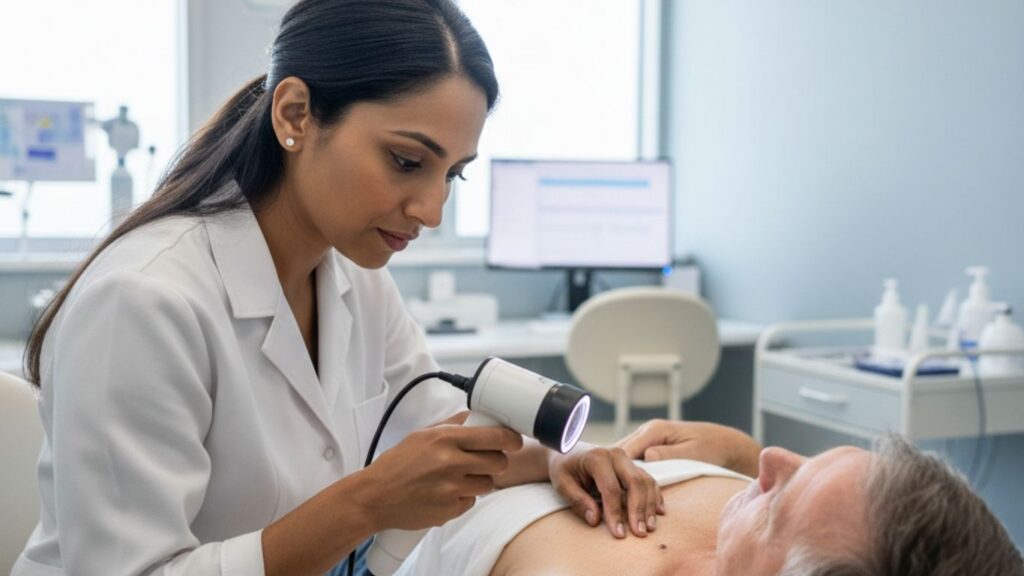
It is the reason why it is important to detect it at an earlier stage of skin cancer. Digital monitoring enables the doctors to detect skin changes as early as possible instead of waiting until they manifest in symptoms. Digital skin mapping is the way of doing this, developing an in-depth visual encounter of your skin, which you can look at and assess later.
Instead of inquiry: does this mole look bad today? skin mapping provides an answer to a more significant question:
Has there been any change in this mole since it was last time?
Such disparity saves lives.
This is because our entire skin cancer check guide shows how skin mapping can be incorporated in the early detection.
The Development of Skin Cancer with Time
When examining why skin mapping is so effective, it is only good to examine how skin cancer actually develops.
Issues of UV damage to skin cells.
The ultraviolet (UV) radiation destroys the DNA within the skin cells. The problem with this is that after many years of receiving sun exposure, errors in cell repair may occur. Such damaged cells can start to grow out of the ordinary and they end up developing skin cancers.
This destruction does not occur overnight. It takes time to accumulate, even decades.
The reason why changes are usually slow.
A great number of skin cancers develop slowly. A mole may:
- Darken slightly
- Grow a bloodless intermittent border.
- Internal change structure.
- Grow by only a millimetre
These minor variations can hardly be observed without taking photographs.
When malignant cancers appear benign.
Early-stage melanoma:From stage A to stage IV, skin cancers are very likely to present:
- Flat
- Small
- Even in colour
- Asymptomatic
This is the reason the outward look is not enough to rely upon. A lesion does not have to appear bad, it simply must change.
This is the principle on which skin mapping is concentrated.
What Is Skin Mapping? (Simple Explanation)
Skin mapping is a technique of keeping a check on your skin by taking a detailed picture of the skin and comparing them to the previous ones over time.
Rather than an isolated check-up, skin mapping is a record of the skin’s healthy status.
In simple terms
- Photographs of your skin of high quality are taken.
- Moles in each person are recorded.
- Images are securely stored
- Images of the future are matched with the images of the past.
This enables physicians to detect the slightest of changes way before signs begin to manifest.
Why appearance is not as important as comparison.
What appears to be a normal mole today may not have appeared so half a year ago. Human beings are not good at recalling fine details of visuals particularly when the changes are gradual.
Digital skin mapping eliminates the guesswork with the aid of objective evidence.
What Is Digital Skin Mapping?
Digital skin mapping involves highly expensive imaging equipment and software that is required to trace skin changes accurately.
It may include:
- Full-body photography
- Dermoscopic pages of the single moles.
- Computer-assisted comparison
- Long-term digital storage
Physicians are able to magnify the structure of the mole, analyze pigment patterns and observe alterations that might not be observed nakedly.
Noteworthily, technology facilitates, and does not displace clinical competence. A qualified skin cancer expert would always be final.
Digital Skin Mapping Systems Typology
Various clinics can have different mapping methods influenced by the risk of patients.
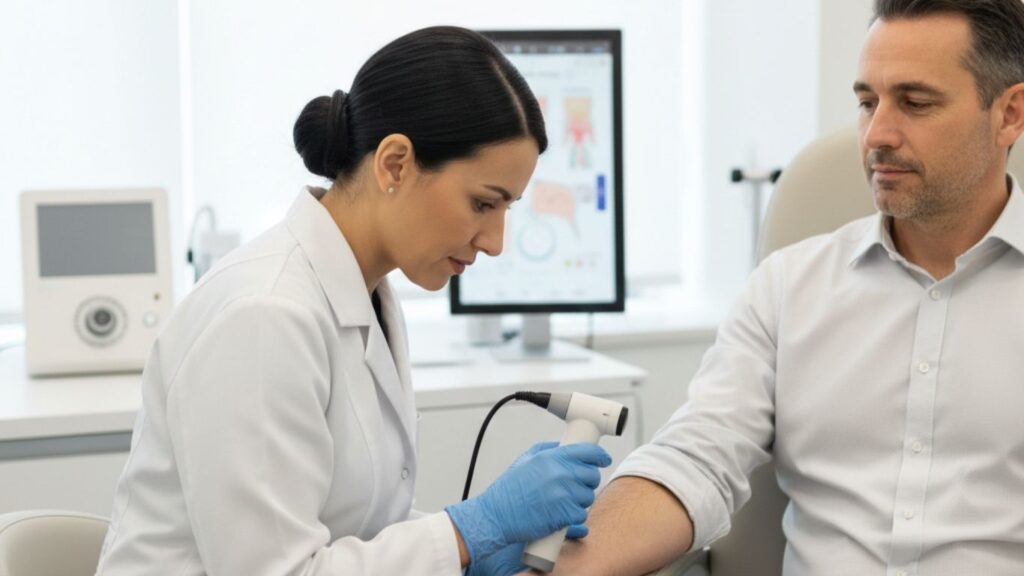
Full-body photography
This is the ability to capture standardised images of the whole skin surface. These images offer a point of reference to compare with in the future and come in very handy when identifying new lesions.
Dermoscopic mole mapping
A dermatoscope is an instrument that enlarges the skin structures that lie below the skin. These images are stored electronically and they are used on subsequent visits.
Digital dermoscopy in a sequence.
In this technique, the same mole is monitored at various moments of time and helps a doctor to detect the internal variation that occurs over a period.
Integrated monitoring mechanism.
Most clinics also integrate all three to offer extensive long-term follow-ups, particularly in patients of a high risk.
Reasons Early Detection Saves Lives.
Early diagnosis significantly improves the prognosis of any kind of skin cancer, especially melanoma.
When detected early:
- Treatment is simpler
- Surgical removal is smaller
- Recovery is faster
- The survival rates are much improved.
Delayed detection may spread the cancer to other layers of the skin or lymph nodes and organs.
Skin mapping enhances early diagnosis since it detects:
- New lesions
- Subtle structural changes
- Gradual changes in pigmentation.
- Asymmetry development
The melanomas are numerous not because they appeared dangerous, but because they used to be not present.
Who Gains the greatest by Skin Mapping
Although it is possible to derive value, there are certain individuals who are particularly useful in long-term skin monitoring.
People with many moles
Patients having 50 or more moles are at greater statistical risk of melanoma. It is almost impossible to observe every single mole applying bare eyes, unless provided with photographs.
Individuals that have unusual or abnormal moles.
Not all moles appear normal so visual evaluation is complicated. Skin mapping assists in differentiating between the harmless irregularity and the actual change.
Individuals who had skin cancer before.
After you have had one skin cancer you have a greater chance of getting another one. Early lesions can be detected with the help of skin mapping.
Physical laborers and sports.
Evidence of high UV radiation among tradescenters, farmers, athletes and the outdoors is attained with years of cumulative UV radiation, despite the use of sun protection.
Family history of melanoma
Genetics plays a role. Overseeing means early prevention as opposed to post-treatment.
To them, a search for skin mapping a long-term skin health plan is common.
Compared to skin checks that qualify as normal, skin mapping can be observed as depth in armoring the heart of darkness.
Compared to standard skin checks, The Skin mapping is skin-deep armoring the heart of darkness.
They are both significant, though they perform varied functions.
Standard skin checks
- Physical examination under a medical professional.
- Determines manifest or symptomatic lesions.
- Efficient in regular screening.
Digital skin mapping
- Tracks skin over time
- Detects subtle change
- Ideal for high-risk patients
Key difference
A standard check answers:
Something smacks of something suspicious today?
Skin mapping answers:
Can it be anything different this time?
A majority of skin cancer clinics suggest the combination of the methods to ensure the best care.
What Skin Mapping Can Detect
Skin mapping assists in tracking any changes that could manifest an early cancer formation.
It can detect:
- The development of new moles at adulthood.
- Alterations in colour distribution.
- Development of border irregularities.
- Structural pigment changes
- Slow growth over time
These results are usual several months before the symptoms manifest.
Which is the frequency of skin mapping that you should have?
The rate is determined by personal risk.
General guidance
- High-risk patients: once in every 6-12 months.
- Moderate risk: every 12-24 months
- Fewer risks: as recommended by your physician.
Consistency is essential. The comparisons get more and more precise the longer the mapping goes on.
Missing follow-ups will make the process less effective.
Far-off advantages of Skin Mapping.
Skin mapping has wider advantages in addition to detection.
Medical benefits
- Greater diagnostic accuracy.
- Earlier intervention
- Fewer missed lesions
Emotional benefits
- Peace of mind
- Reduced anxiety
- Confidence in monitoring
Practical benefits
- Fewer unnecessary biopsies
- Objective documentation
- The presence of appropriate clinical decision-making.
The fact that their skin is carefully monitored makes many patients reassured.
Skin Mapping and Prevention
Avoiding prevention supports prevention and encourages:
- Regular medical reviews
- Better practices of sun protection.
- Increased awareness of the changes in the skin.
- Long-term health planning
Together with the use of sunscreens, protective clothing, and avoiding UV, it becomes a powerful prevention measure.
Writing on Skin Mapping Appointment.
Before your visit
- Avoid fake tan
- drawer removal is advisable (nail polish).
- Note any spots of concern
- Wear comfortable clothing
During the appointment
- There is respect in taking photos.
- Privacy practices are taken into consideration.
- Images are securely stored
- The privacy of your comfort and privacy is important.
Some Myths Concerning Skin Mapping.
- “It replaces skin checks”
No, it enhances them. - Only people that have cancer can do it.
No, it is used preventatively by many patients. - “Only large moles matter”
No, there are melanomas which may start very tiny.

Frequently Asked Questions
1: Is skin mapping painful?
No. Post-analysis refers to the point where skin mapping is completely non-invasive. It consists only of photography and visual investigation. There are no needles, injections, and discomfort.
2: How time consuming is a routine skin mapping appointment?
Most of the moles require imaging, which varies in length according to the number of moles and the imaging.
3: Is digital skin mapping safe?
Yes. It takes place solely using photographs with no radiation exposure and no exposure harmful.
4: Is skin mapping able to identify melanoma at an early stage?
Yes. It works especially well in detecting early melanoma due to change detection being subtle.
5: Do I have to continue to have frequent skin checks?
Yes. Skin mapping can be effectively used with professional clinical examination.
6: Is skin mapping appropriate among younger adults?
Yes, particularly those of the moles with a great family history.
7: How accurate is skin mapping?
Skin mapping is extremely beneficial in enhancing the accuracy of detection in the early stages when assessed by experienced clinicians.
8: What will be the outcome in case a change is identified?
Depending on findings, monitoring, or biopsy, or even early removal can be recommended by your doctor.
Final Thoughts
The concept of skin mapping has revolutionised the way skin cancer diagnosis and treatment have been. It enables doctors to detect cancers at an earlier stage, when they are easier to treat and the prognosis is less disadvantageous, as the emphasis is not on the appearance.
To people who have more than one mole, has been diagnosed with skin cancer previously, or is exposed to a lot of sun, skin mapping is one of the proactive choices that one can consider regarding the long run health.
Our skin cancer check list does give details on how our skin mapping can be incorporated into early detection.
Defend Your Skin by Continued Surveillance.
Preservation saves houses and regularity is a plus to survival.
Regardless of it being your first skin check or a continuation of a regular check, it is important to know that when you hire expert care, changes are detected in a timely manner that is both precise and safe.Make a consultation with Canberra Skin Cancer Clinic Today!
| Canberra Skin Cancer Clinic- Green Way | Canberra Skin Cancer Clinic- Molonglo Valley |
| Phone: (02) 6100 9956 | Phone: (02) 5110 3155 |
| Email:reception@greenwaymedicalcentre.com.au | Email: reception@greenwaymedicalcentre.com.au |
| Address: Unit 6/175 Anketell Street, Greenway ACT 2900 | Address: 110 Woodberry Ave Coombs ACT 2611 |
| Website: https://canberraskincancerclinic.com.au/ | Website: https://canberraskincancerclinic.com.au/ |