

Canberra has a lot of lifestyle advantages including expansive spaces and an outdoor lifestyle. There is a combination of parks, bushlands, sporting grounds and walk tracks which have become part of the day to day lives of many residents in the area. Nonetheless, the drawback of such exposure is that skin health needs periodic consideration especially in an area where ultraviolet (UV) rays are high.
Skin cancer clinics have a significant job in assisting individuals to comprehend the alteration in their skin, keep track of the prolonged sun damage and remain updated on their danger. In the case of most of the patients, there is a sense of uncertainty. Individuals are frequently asked what does actually occur during an appointment, and how frequently one requires checks and what is the kind of care that is provided in the area.
This guide describes what Canberra residents should expect whenever visiting a skin cancer clinic, how treatment is normally provided, and reasons as to why office interventions are crucial in the Canberra climate. The objective is to deliver qualitative information in an easy-to-understand manner to ensure that the people and families are sure that they can take care of their skin.

Skincare, Canberra, why it matters.
The environment and location of Canberra poses certain problems to the protection of skin.
The city has lower temperatures in winter than many other Australian places, but due to its high UV radiation all year round. Scattered clouds, elevated height, and outdoor living fixate on accrued sun exposure in the long term.
The area has quite a number of residents who have been in the area for decades, most of them since childhood. The effects of sun damage accumulate gradually and it may take many years before the effects change, which is not readily noticeable.
Key local factors include:
- Intense UV radiations in spring and summer.
- Blue skies give an illusion of safety.
- Construction, landscaping, defence and public services Outdoor work.
- Sports, gardening and bushwalking exposure to the sun.
- Permanent harm of previous years before improved awareness of sun protection occurred.
Due to this fact, routine skin check has emerged as a significant element of preventative healthcare among the individuals in the ACT.
Knowledge of a Skin Cancer Clinic Role
A skin cancer clinic involves the evaluation, observation, and treatment of changes on the skin that could be subject to medical care. Such clinics are meant to do a comprehensive study of the skin and monitor progress over time.
Compared to general medical consultation where the patient may be dealing with one issue at a time, skin-based clinics examine every part of the skin surface, including those that are not easily visible at home.
Their role includes:
- Conducting skin tests, full or partial.
- Determining changes that might require a closer examination.
- Observation of the presence of moles/ lesions.
- Offering instruction regarding sun protection and self-check.
- Making certain follow-ups when necessary.
The purpose is to prevent panic among patients, yet identify changes at the early stages and promote the continuation of skin health in a systematic and uniform manner.
Who Will Generally Find It Useful to Monitor the Skin?
Even though anyone can be the beneficiary of the periodical checks, there are also certain groups in Canberra that can find this very useful.
This includes people who:
- Have much time outside of work or leisure.
- He has fair skin, which burns readily.
- Previously sun exposure was already in life.
- Have many moles or freckles
- Of a spot that has an altered aspect noticed.
- Possess a skin cancer history in the family.
- Are over the age of 40
Notably, a lot of individuals visit clinics when they are not facing any apparent issues, just in order to define a new point of reference to interact with in future.
The Preset Before you are Appointed.
Patients are normally requested to fill in a brief medical history before they visit a clinic. This can assist clinicians to know the risk factors of an individual, and whether he/she had any previous skin issues.
You may be asked about:
- History of skin check procedure or treatment.
- Skin cancer in family history.
- Time spent working outdoors
- Past history of sunburn especially in childhood.
- Any spots which change or bleed or get irritated.
Wearing makeup, nail polish or fake tan on the day of your appointment ensures it is not difficult to assess either.
The collection of clothes that can be taken off without difficulties also contributes to the process of examination being even more relaxed.
Before, During, and After a Skin Examination.
An average appointment is relaxation-filled, systematic, and non-hurried.
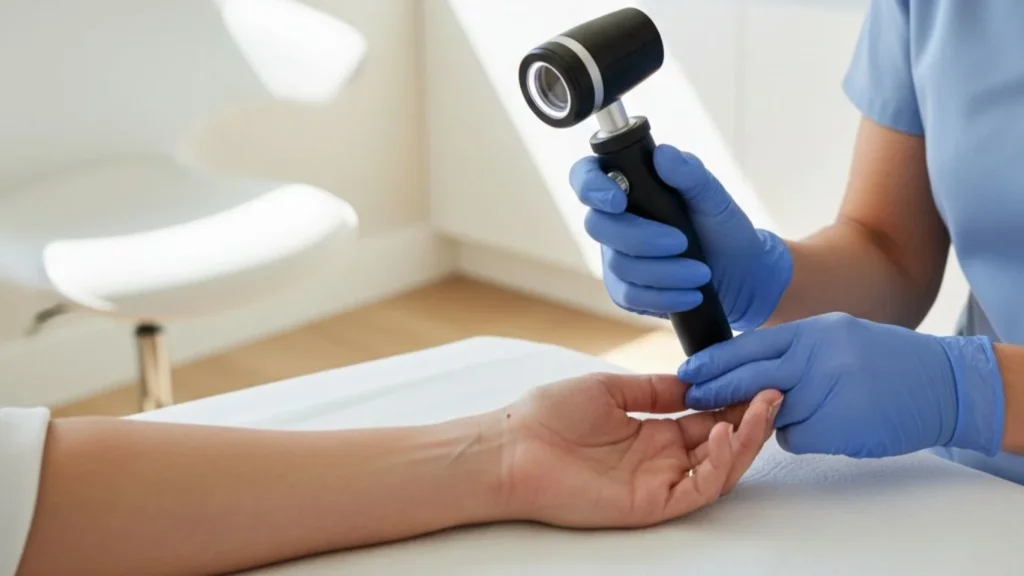
Initial discussion
The clinician will in most cases initiate by asking about your history and inquiring on whether there are certain areas of concern. The patients are invited to indicate any new, changing, or uncomfortable things.
Visual skin assessment
The test entails a skin examination head to toe. This incorporates things that are likely to be overlooked when self checking such as:
- Scalp
- Behind the ears
- Back of the neck
- Under the breasts
- Between fingers and toes
- Soles of the feet
During its process, keep, and comfort are given the first priority.
Use of magnification
Specialised magnifying tools are used in many clinics in order to examine the skin structure in greater detail. This enables the appraisal of subtle changes below the surface to be evaluated more distinctly.
Documentation
In case it is necessary to monitor certain spots, a picture or notes can be recorded to see the difference over time. This aids in developing a long term view of the state of your skin.
It typically does not cause pain and is aimed at being comforting in nature as opposed to stressful.
The Time It Takes to Appoint an average person.
The length of appointment also may depend on the kind of check that is being conducted.
In general:
- Special spot checks can be as short as 10-15 minutes.
- The time spent examining the skin in full can be related as 20-30 minutes.
- Detailed measures can be a little bit more prolonged.
Questions, explanations, and discussion of the further steps are typically allowed should there be any suggestion of monitoring taking place.
Follow-Up and Monitoring.
Not all spots deserve to be acted upon. Generally, a safe course of action is a close observation as time progresses.
Monitoring may involve:
- Revising a spot 36 months later.
- side by side comparison of images to show minor variation.
- Monitoring moles which seem stable but bizarre.
- Taking baseline photos to insure consistency also Adding comparison photos later on.
Such formal follow up is particularly effective amongst the individuals that experience several moles, or those who are known to be exposed to the sun over extended periods of time.
To find out the full way to see the full picture of skin cancer detection and life-long monitoring, consult our comprehensive section of the guide to skin cancer examination in Canberra.
Canberra Jonzee Sun and UV.
Most individuals think that there is no sun risk when the weather changes to lower temperatures. The truth of the matter is that UV radiation does not act like heat.
Seasonal factors
In Canberra:
- The level of UV can be high during the period between September and April.
- There is usually intense UV in the spring before one changes their sun habits.
- A day of cool temperatures still can include dangerous exposure.
- Bouncing of light and concrete surfaces predisposes danger.
It implies that the necessity of skin protection and monitoring is still significant in a lot of the years.
Long-term exposure patterns
People who have resided in Canberra for a long period might have acquired sun exposure without even knowing. Injuries form gradually and might not present themselves in a few decades.
Home checks come with regular reviews, which allows detecting changes during the initial stages that may not be noticeable.
Skin Care access and Costs in Canberra.
The prices of skin assessment can be different according to a range of factors, such as appointment duration and services.
Although there is no standardized cost among clinics, the individual factors that can affect cost could include:
- Complete checks and specific checks.
- Imaging– use of imaging or monitoring technology.
- Length of consultation
- Follow-up appointments
In certain cases, some services are partly covered as per the individual cases though the patients are largely advised to always check and confirm with the clinic before going.
Notably, routine check-ups are considered by many patients as a bargaining gambit in future health.
Mistakes about Skin Checks.
Although there is increased awareness, some misconceptions are existing and they are keeping the people from seeking timely care.
I would perceive there was something wrong.
Some of the changes in the skin are minimal and painless. Certain parts are hard to observe without assistance and so professional examinations are useful.
“It doesn’t look serious”
All worrying spots are not dark, raised or dramatic. There are those changes that are flat, mildly coloured or gradual to develop.
“I only need to check moles”
Changes within the skin may take place in various shapes and not through moles alone. Review can also be considered in the case of dry patches, scaly areas or non-healing sores.
“Winter means I’m safe”
Exposure of UV in Canberra is not eliminated during cooler months especially when there are clear days.
The Role of Examining the Skin at every part of the body
Self-checks are useful but they tend to overlook the spots including:
- The scalp
- Upper back
- Backs of legs
- Behind ears
- Soles of feet
Clinics are in a position to scrutinize these areas, in an adequate manner and make sure that nothing is missed.
This is a comprehensive method that makes professional skin monitoring one of its advantages.
Weekly Interim Security Briefings.
In case of scheduled visits, you only need to be conscious of your skin.
Among the interesting changes worthy of mention are:
- An irregularity that varies in size, shape, or colour.
- A soreness that is either itchy, tender or scaly.
- A sore that does not heal
- A fresh point that does not match the others.
- Any growth that concerns you
A basic inventory, like photos or a journal kept at home may aid you to perceive changes that have been happening slowly with time.
Right Care Choices in Canberra.
Continuity and thoroughness appeal to most patients when it comes to skin care in the local area.
Depreciated desirable attributes invariably comprise:
- Dermatologists with skin evaluation experience.
- Improved explanations in a simple language.
- Extensive physical checkups.
- Organized recall/follow up systems.
- Courteous, slow-moving schedules.
LRC comfort in asking questions and comprehending recommendations is a considerable aspect.
The Importance of Education and Prevention.
Examination is not the sole thing in skin cancer clinics. Education is also relevant in aiding the patient to lower risk in the future.
It usually involves instructions on:
- Proper sunscreen use
- Hats and protective clothing.
- Timing outdoor activities
- Early skin recognition of changes.
- Establishing long-term sun-safe behaviors.
The cumulative level of exposure is a lot less with little daily decisions.
Knowing about Skin Health in families.
The habits of skin protection might start during childhood. Key factors contributing to this trend in Canberra families are sun protection and awareness among many families.
Checks may be selected by parents as a means of:
- The healthy behaviour modelling.
- Learning about hereditary risk.
- Knowing what normal changes that are happening on the skin appear to be like.
- Scheduling checking schedules.
Whereas, in adults, routine examinations are more frequent, early alert is beneficial to the entire household.
Outdoor Workers in the ACT
Outdoor workers have their own issues.
This includes those in:
- Construction
- Landscaping
- Farming and rural work
- Emergency services
- Defence-related roles
Sustained exposure to UV during the high levels of the sun predisposes an individual to long-term risk. Monitoring works well to identify change early and facilitate planning of health at the workplace.
Emotional Comforters About Skin Checks.
It is understandable to be nervous when having an appointment, particularly the first visitors.
The experience of it is much less complex than expected by most people. Examinations are typically slow, inquisitive and less troubled with time.
It is common to know ahead of time what to look forward to and make the patient feel more empowered in their health choices.

Lessons to Canberra Residents.
- Much of the year, the UV exposure of Canberra is still strong.
- The changes on the skin are usually slow and asymptomatic.
- Professional tests aid in the identification of insidious variations.
- Both monitoring over time and checks that are one-off are the norm.
- Care is characterized by education and prevention.
- Self-care of the skin is not a short-term phenomenon.
Frequently Asked Questions
1: What is the frequency of skin checks of Canberra residents?
In Canberra, a skin review after every 12 months is recommended to many adults. Individuals who are more exposed to the sun or those with light skin, as well as those with past issues might be encouraged to visit more often. A more appropriate schedule can be proposed by your clinician and is applicable depending upon your respective risk profile and lifestyle.
2: Do we need skin checks at the time of the winter in the ACT?
Yes. Even on cool or cloudy days UV radiation may be present in Canberra. Checks can also be good in a winter period because clinics are not so busy, and the alterations observed at that time can be followed before summer exposure peaks. Skin health is a thing that needs a concern throughout the year, rather than seasonally.
3: What is going to occur in case anything suspicious is discovered?
In case a spot needs special care, the clinician will give the reasons and the direction further. This can involve the short-term observation, the further investigation or the referral to the further observation. They are typically planned and explained so that the patients have time to get to know about the process and ask questions.
4: How long does a full skin check usually take place?
A full examination typically takes between 20 and 30 minutes. This allows time for discussion, assessment, and documentation. Appointments may take longer if multiple areas need monitoring or if it is your first visit and a detailed history is required.
5: Who is at higher risk in the Canberra region?
People with fair skin, a history of sunburn, outdoor occupations, or long-term residence in Australia often have higher cumulative sun exposure. Age can also increase risk due to lifelong UV damage. However, anyone living in the ACT can benefit from understanding their individual skin health needs.
Taking a proactive approach to Canberra Skin Cancer Clinic residents stay informed, confident, and supported. With clear information and regular monitoring, caring for your skin becomes a manageable and reassuring part of everyday health.
Book a Skin Cancer Specialist Consult.
Early evaluation is all you need just in case you have observed a shifting area, a family history of skin cancer, and just need professional confirmation.
An expert dermatologist is able to assess your risk, closely investigate your skin and provide you with the best alternative of monitoring action.
Get your skin cancer today and have peace and early intervention.
| Canberra Skin Cancer Clinic- Green Way | Canberra Skin Cancer Clinic- Molonglo Valley |
| Phone: (02) 6100 9956 | Phone: (02) 5110 3155 |
| Email:reception@greenwaymedicalcentre.com.au | Email: reception@greenwaymedicalcentre.com.au |
| Address: Unit 6/175 Anketell Street, Greenway ACT 2900 | Address: 110 Woodberry Ave Coombs ACT 2611 |
| Website: https://canberraskincancerclinic.com.au/ | Website: https://canberraskincancerclinic.com.au/ |