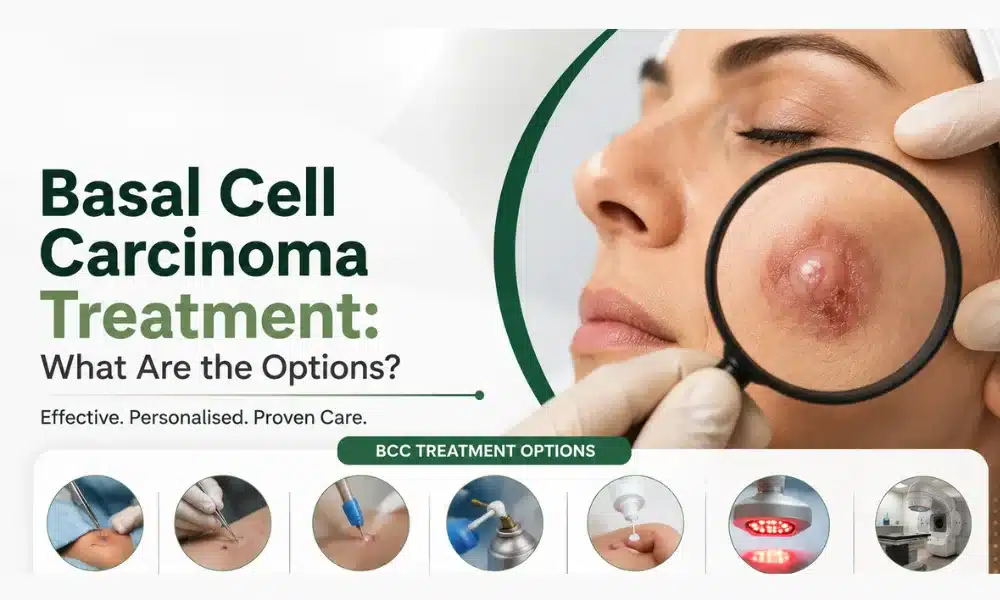
Basal Cell Carcinoma Treatment: What Are the Options?
Being told you have basal cell carcinoma (BCC) can naturally lead to questions about what happens next. Will you need surgery? Can BCC be treated without surgery? Is Mohs surgery necessary? And how long does treatment take?
The good news is that basal cell carcinoma is usually highly treatable, particularly when it is found early. There are several treatment approaches, and the right option depends on factors such as the type, size, and location of the BCC, whether it has returned, and your overall health.
Let’s look at the main basal cell carcinoma treatment options and when they may be considered.
What Is Basal Cell Carcinoma?
Basal cell carcinoma is the most common type of skin cancer. It develops from basal cells in the epidermis, the outer layer of the skin.
BCC commonly appears in areas that receive significant sun exposure, particularly the:
- Face
- Nose
- Ears
- Neck
- Scalp
- Shoulders
- Back
It generally grows slowly and rarely spreads to other parts of the body. However, an untreated BCC can continue growing into nearby tissue and may become more difficult to remove.
Because BCC can sometimes look like an ordinary skin spot, soreness, or irritation, diagnosis by a qualified healthcare professional is important.
How Is Basal Cell Carcinoma Diagnosed Before Treatment?
Before deciding on treatment, your doctor needs to confirm that the lesion is actually BCC and understand its characteristics.
A skin examination may involve a dermatoscope, which allows the doctor to examine a suspicious lesion more closely. If necessary, a skin biopsy may be performed and sent to a pathology laboratory for examination.
The diagnosis and pathology results help guide the treatment plan.
What Are the Main Basal Cell Carcinoma Treatment Options?
There isn’t one treatment that is right for every BCC. Your doctor may consider:
- Surgical excision
- Mohs micrographic surgery
- Curettage and electrodesiccation
- Cryotherapy
- Topical treatments
- Photodynamic therapy
- Radiation therapy
- Specialist treatments for advanced BCC
Let’s look at each option in more detail.
1. Surgical Excision
Surgical excision is one of the most common treatments for invasive BCC.
During an excision, the doctor removes the BCC along with a margin of surrounding skin. The removed tissue is generally sent to a pathology laboratory so it can be checked for cancer cells at the margins.
If the pathology shows that the cancer has not been completely removed, additional treatment may sometimes be recommended.
When may excision be considered?
It may be suitable for many BCCs, particularly when the lesion can be safely removed with an appropriate margin.
The procedure is commonly performed using a local anesthetic, meaning the area is numbed while you remain awake.
The wound may be closed with stitches. For larger wounds, a skin flap or graft may sometimes be required.
2. Mohs Micrographic Surgery
Mohs surgery is a specialized technique designed to remove skin cancer while preserving as much healthy tissue as possible.
During Mohs surgery, the doctor removes the cancer in stages. Each layer is examined under a microscope before another layer is removed. The process continues until no cancer cells are seen in the tissue being examined.
Mohs may be considered for BCCs that:
- Have poorly defined edges
- Have returned after previous treatment
- Are located in areas where preserving healthy tissue is especially important
- Occur near structures such as the eyes, nose, lips, or ears
- Have characteristics that make complete removal more challenging
It is not necessary for every BCC. Your doctor or specialist can assess whether Mohs is appropriate for your particular situation.
3. Curettage and Electrodesiccation
This treatment involves removing the cancerous tissue with a small spoon-shaped instrument called a curette. Heat is then applied to the area to help control bleeding and destroy remaining abnormal cells.
Curettage and electrodesiccation may be considered for selected BCCs, particularly some smaller and suitable lesions.
It isn’t appropriate for every type or location of BCC, so proper assessment is important before choosing this approach.
4. Cryotherapy
Cryotherapy, or freezing treatment, uses liquid nitrogen to destroy abnormal cells.
It can be used for some small superficial BCCs and certain other sun-related skin lesions.
The treated area may become red, swollen, or blistered before healing.
Because cryotherapy does not allow the doctor to examine the entire removed lesion in the same way as surgical excision, it is generally reserved for appropriately selected lesions.
5. Topical Treatments
Some superficial BCCs may be treated with prescription creams or other topical medicines.
Depending on the individual case, treatments may include medicines such as:
- Imiquimod
- Fluorouracil (5-FU)
These treatments work at the skin level and may be suitable for carefully selected superficial cancers. Cancer Council Australia lists topical creams among treatment options for superficial BCC.
Topical treatment isn’t suitable for every BCC, particularly lesions that are deeper or have higher-risk features.
6. Photodynamic Therapy
Photodynamic therapy (PDT) combines a light-sensitive medicine with a specific light source.
The medicine is applied to the affected skin and then activated using light, helping destroy abnormal cells.
PDT can be considered for some superficial skin cancers and selected BCCs.
As with topical treatment, careful assessment is needed to determine whether the BCC is suitable.
7. Radiation Therapy
Radiation therapy uses controlled radiation to destroy cancer cells.
It may be considered for certain BCCs where surgery isn’t suitable or where other factors make radiation an appropriate alternative. It can also have a role in selected more complex cases.
The decision depends on the individual cancer and the person’s overall circumstances.
8. Treatment for Advanced Basal Cell Carcinoma
Most BCCs are managed with local treatment, but locally advanced or metastatic BCC is uncommon.
When a BCC is advanced and cannot be appropriately managed with standard local treatments, specialist teams may consider additional treatments, including targeted therapies. Australian cancer guidance notes hedgehog pathway inhibitors such as vismodegib and sonidegib for locally advanced or metastatic BCC in appropriate circumstances.
These treatments are generally managed by specialists and are not required for the majority of people with BCC.
Which Basal Cell Carcinoma Treatment Is Best?
There is no single “best” treatment for every person.
Your doctor may consider:
The type of BCC
Some BCC subtypes are more suitable for particular treatments than others.
The size of the cancer
Larger lesions may require a different approach from small, superficial lesions.
The location
Treatment on the nose, eyelid, ear, lip or another cosmetically or functionally important area may require particularly careful planning.
Whether the BCC has returned
A recurrent BCC may require a more specialized treatment approach.
Whether the cancer has deeper or higher-risk features
Higher-risk BCCs may need specialist assessment and treatment.
Your general health
Other medical conditions and medicines you take can influence treatment decisions.
Cancer Council Australia recommends considering the cancer’s type, size and location, as well as general health, medicines, and whether the cancer has spread, when determining treatment.
Is Surgery Always Needed for BCC?
No.
Surgery is the most common treatment for many BCCs, but selected superficial BCCs may be treated using options such as cryotherapy, curettage and electrodesiccation, topical treatments or photodynamic therapy.
However, avoiding surgery isn’t automatically better. The goal is to choose a treatment that provides appropriate cancer control while considering the location, appearance and function of the affected area.
Your doctor can explain why a particular treatment has been recommended and what alternatives may be available.
What Happens After Basal Cell Carcinoma Treatment?
Treatment doesn’t necessarily mean you can forget about skin cancer.
Having had one BCC can increase your risk of developing another BCC in the future. Regular skin checks and knowing what changes to look for can therefore be important.
You should also continue protecting your skin from UV exposure.
Practical sun-protection measures include:
- Wearing protective clothing
- Using SPF 30+ sunscreen
- Seeking shade
- Wearing a broad-brimmed hat
- Avoiding unnecessary UV exposure
- Checking your skin regularly
Cancer Council Australia notes that more than 95% of skin cancers are caused by UV exposure, making sun protection an important part of prevention.
When Should You See a Skin Cancer Doctor?
Don’t wait for a skin lesion to become painful before having it checked.
BCC can have very few symptoms. A suspicious spot may appear as a pearly lump, shiny pink area or dry/scaly patch, and some lesions can bleed, crust or repeatedly heal and return.
Consider arranging a professional assessment if you notice:
- A new or unusual skin lesion
- A sore that doesn’t heal
- A spot that repeatedly crusts or bleeds
- A pearly or shiny lump
- A patch that continues to change
- A lesion that looks different from the surrounding skin
- A previously treated area that develops a new or changing spot
Early assessment can help determine what the lesion is and whether treatment is required.
Basal Cell Carcinoma Treatment in Canberra
If you’ve noticed a suspicious skin lesion or have been diagnosed with BCC, a professional skin assessment can help determine the next step.
At Canberra Skin Cancer Clinic, skin concerns can be assessed with appropriate examination and diagnostic procedures, with treatment recommendations based on the individual lesion and clinical findings.
If you are concerned about a changing, bleeding, or non-healing skin lesion, don’t ignore it simply because it doesn’t hurt. Arrange an assessment with a qualified skin cancer healthcare professional.
Frequently Asked Questions
Is basal cell carcinoma curable?
BCC is usually highly treatable, particularly when detected early. The treatment selected depends on the individual cancer, including its type, size, and location.
What is the most common treatment for basal cell carcinoma?
Surgical excision is the most common treatment for many invasive BCCs. However, other treatments may be appropriate for selected lesions.
Can basal cell carcinoma be treated without surgery?
Yes. Selected superficial BCCs may be treated with options such as cryotherapy, curettage and electrocoagulation, topical treatments, or photodynamic therapy. Suitability depends on the individual lesion.
Is Mohs surgery used for basal cell carcinoma?
Yes. Mohs micrographic surgery is used for selected BCCs, including some cancers with poorly defined edges, recurrent cancers, and lesions in areas where preserving healthy tissue is particularly important.
Does basal cell carcinoma need to be removed?
BCC generally needs appropriate treatment rather than simply being ignored. Although it usually grows slowly and rarely spreads, untreated BCC can invade and damage nearby tissue.
Can BCC come back after treatment?
A BCC can recur after treatment, and people who have had one BCC are also at increased risk of developing another skin cancer. Ongoing skin checks and sun protection are therefore important.
How long does basal cell carcinoma treatment take?
The timeframe depends on the treatment. Some procedures can be completed during a consultation, while surgical or specialist treatments may involve additional appointments, pathology, and follow-up.
Should I get a skin check after BCC treatment?
Yes. Follow-up is important because you may be at increased risk of developing another BCC or other skin cancer. Your doctor can recommend a follow-up schedule based on your individual risk.
Book a skin check with Canberra Skin Cancer Clinic if you have concerns about a suspicious or sun-damaged spot.
| Canberra Skin Cancer Clinic- Green Way | Canberra Skin Cancer Clinic- Molonglo Valley |
| Phone: (02) 51046409 | Phone: (02) 51046409 |
| Email: reception@greenwaymedicalcentre.com.au | Email: reception@greenwaymedicalcentre.com.au |
| Address: Unit 6/175 Anketell Street, Greenway ACT 2900 | Address: 110 Woodberry Ave Coombs ACT 2611 |
| Website: https://canberraskincancerclinic.com.au/ | Website: https://canberraskincancerclinic.com.au/ |