
Actinic Keratosis Treatment: When Does Sun Damage Need Treatment?
A rough, dry patch on your skin may seem harmless, especially if it has been there for a while. But sometimes that rough patch is more than just dry skin.
Actinic keratosis (AK), also called solar keratosis, is a common sign of long-term sun damage. It usually appears as a rough or scaly spot on areas that receive a lot of ultraviolet (UV) exposure, such as the face, scalp, ears, hands, forearms, and legs.
Actinic keratoses are not the same as skin cancer, but they are considered precancerous lesions because some can develop into squamous cell carcinoma (SCC).
So, when does sun damage need treatment? And how do you know whether an actinic keratosis can simply be monitored or should be treated?
Let’s take a closer look.
What Is Actinic Keratosis?
Actinic keratosis develops when skin cells become damaged by repeated exposure to UV radiation over time.
You may notice an AK as:
- A rough or sandpaper-like patch
- A dry, scaly spot
- A red or pink patch
- A skin-colored rough area
- A thicker, crusty lesion
- A spot that feels rougher than it looks
They commonly develop on sun-exposed areas such as the face, scalp, ears, hands, forearms, and legs. They are particularly common with increasing age, although younger people with significant UV exposure can also develop them.
An actinic keratosis is essentially a visible sign that the skin has experienced significant cumulative sun damage.
Does Every Actinic Keratosis Need Treatment?
Not necessarily, but every suspicious or persistent lesion deserves proper assessment.
Some actinic keratoses may be monitored, while others may be treated because of their appearance, symptoms, thickness, number of lesions, location, or potential risk of progression.
Treatment may also be considered when there are multiple areas of sun-damaged skin rather than just one obvious spot.
Your doctor can assess the area and determine whether it is likely to be an actinic keratosis or whether a biopsy or different treatment is needed.
This distinction matters because not every rough or scaly spot is an actinic keratosis. Some skin cancers and other skin conditions can look similar.
Why Treat Actinic Keratosis?
There are several reasons a doctor may recommend actinic keratosis treatment.
1. To treat existing sun-damaged skin
Treatment can remove or destroy the abnormal cells within an actinic keratosis.
2. To reduce the risk of progression
Actinic keratoses can occasionally progress to SCC. Treating appropriate lesions can therefore be part of managing ongoing sun damage.
3. To relieve symptoms
Some AKs can become itchy, tender, irritated, or uncomfortable, particularly when they are thick or repeatedly rubbed.
4. To manage multiple areas of sun damage
If there are numerous AKs across an area such as the scalp or face, your doctor may recommend a treatment that addresses a wider area rather than treating individual spots one at a time.
What Does Actinic Keratosis Treatment Involve?
There is no single treatment that is right for every actinic keratosis.
The choice can depend on:
- The number of lesions
- Their size and thickness
- Their location
- Whether they are causing symptoms
- The amount of surrounding sun damage
- Whether there is any concern about skin cancer
- Your previous treatment history
- Your overall health and individual circumstances
Common treatment approaches include cryotherapy, prescription creams or gels, curettage, and photodynamic therapy.
1. Cryotherapy for Actinic Keratosis
Cryotherapy is one of the commonly used treatments for individual actinic keratoses.
Liquid nitrogen is applied to the lesion, freezing the abnormal cells. The treated area may become red, swollen, or blistered before the skin heals.
Cancer Council Australia lists cryotherapy as a treatment used for sunspots and some early skin cancers.
Cryotherapy can be particularly useful when there are a small number of clearly defined lesions.
What happens after cryotherapy?
The treated area may:
- Become red
- Feel tender
- Form a blister
- Peel or crust
- Take a few weeks to settle
Your doctor will provide appropriate aftercare instructions.
2. Prescription Creams and Gels
For some people, topical treatment may be appropriate, particularly when there are multiple actinic keratoses across an area of sun-damaged skin.
Depending on the individual circumstances, prescription treatments may include medicines such as:
- 5-fluorouracil (5-FU)
- Imiquimod
- Diclofenac
These treatments work differently, and the appropriate medicine, application schedule, and treatment area should be determined by a healthcare professional.
For example, Australian medicines information lists fluorouracil products for the topical treatment of actinic keratosis, including on the face, ears, and/or scalp for appropriate patients.
What should you expect from a topical treatment?
The treated skin can become noticeably red, irritated, sore, scaly, or crusted.
This can sometimes look worse before it improves.
That reaction does not necessarily mean something has gone wrong, but you should follow your doctor’s instructions and contact them if you develop concerning or severe symptoms.
Don’t use a prescription cream on a suspicious lesion without first having it assessed. A skin cancer can sometimes resemble an actinic keratosis, and the correct diagnosis matters.
3. Photodynamic Therapy
Photodynamic therapy (PDT) uses a light-sensitive cream followed by a specific light source to treat abnormal cells.
It can be useful for selected areas of sun damage, particularly when there are multiple lesions or a wider area needs treatment.
Cancer Council Australia lists PDT as an option for treating sunspots and selected superficial skin cancers.
PDT may cause:
- Burning or stinging
- Redness
- Swelling
- Tenderness
- Temporary irritation
Your doctor will explain what to expect and how to protect the treated area afterwards.
4. Curettage
For selected lesions, a doctor may use curettage, where abnormal tissue is removed using a small instrument called a curette.
The technique can be used for certain skin lesions and cancers, but it isn’t suitable for every actinic keratosis.
If a lesion looks suspicious for an invasive skin cancer, your doctor may recommend a different procedure or biopsy so the tissue can be assessed appropriately.
When Does an Actinic Keratosis Need More Urgent Assessment?
One of the most important things to remember is that a lesion should not automatically be assumed to be an actinic keratosis just because it is rough or sun-damaged.
Arrange a professional assessment if a spot:
- Becomes noticeably thicker
- Starts bleeding
- Becomes persistently painful or tender
- Develops a persistent ulcer or sore
- Grows quickly
- Changes significantly
- Becomes increasingly crusted
- Does not respond as expected to treatment
- Looks different from your other sun-damaged spots
These changes don’t necessarily mean that the lesion is cancerous, but they are reasons to have it checked.
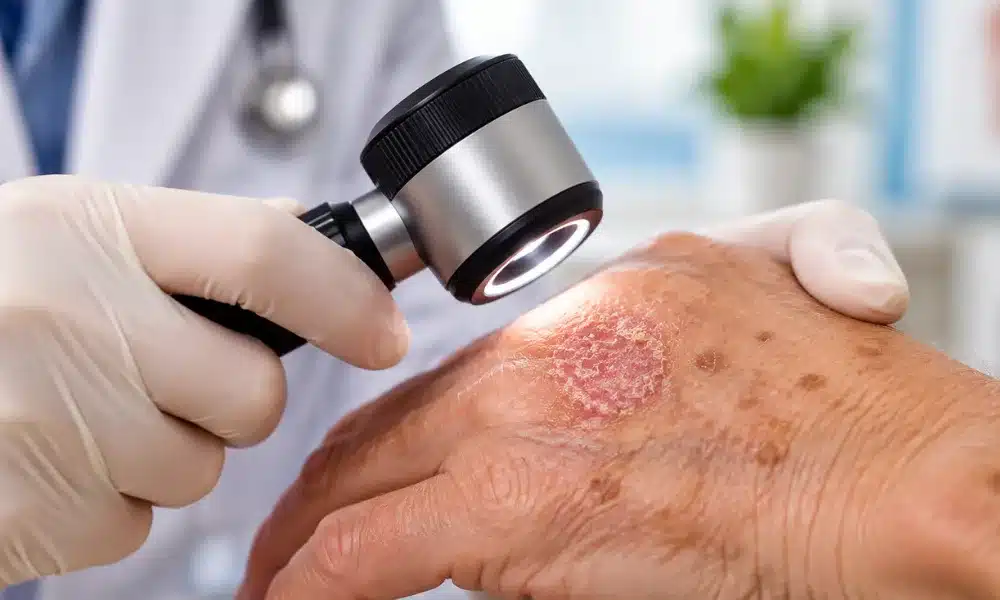
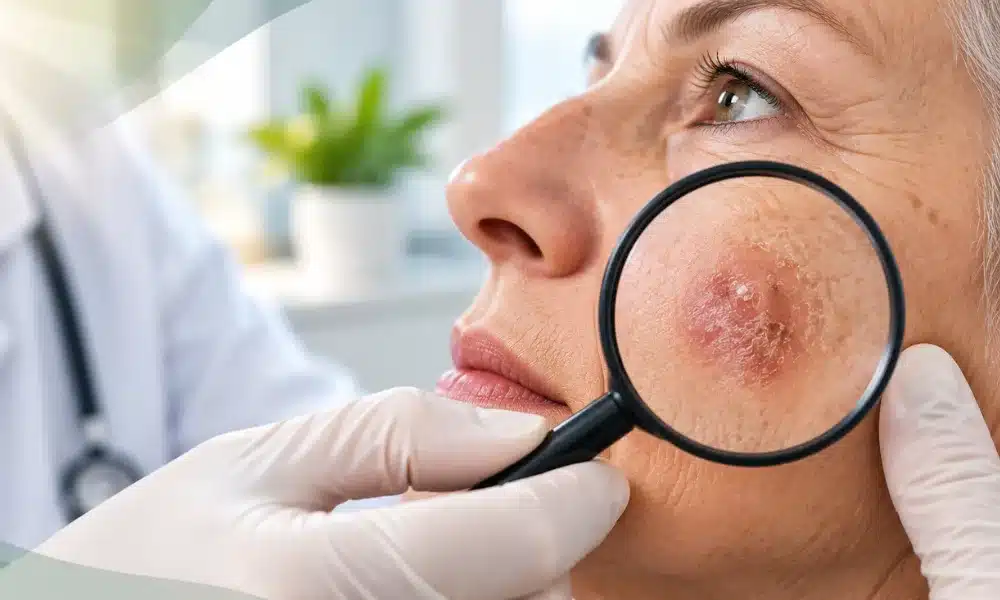
A doctor may use a dermatoscope to examine the lesion more closely and may recommend a biopsy if the diagnosis is uncertain.
Can Actinic Keratosis Turn Into Skin Cancer?
Yes, some actinic keratoses can progress to squamous cell carcinoma (SCC).
However, this does not mean that every actinic keratosis will become cancer.
Cancer Council Australia describes actinic keratosis as a marker of sun damage and notes that it may, on rare occasions, develop into SCC.
This is why persistent or changing lesions should not simply be ignored.
Treating appropriate actinic keratoses is one part of managing sun-damaged skin, alongside regular skin checks and good UV protection.
Can Actinic Keratosis Come Back After Treatment?
Yes.
Treatment can remove or control the treated lesion, but it doesn’t reverse all of the underlying sun damage in your skin.
As a result, new actinic keratoses may develop in the future, particularly if the skin continues to receive significant UV exposure.
Think of treatment as dealing with the current problem—not as erasing years of accumulated sun exposure.
This is why ongoing skin awareness and sun protection remain important.
What About Actinic Keratosis on the Scalp?
Actinic keratoses are common on the scalp, particularly in people with thinning hair or little hair covering the scalp.
A rough, scaly patch on the scalp may be difficult to see yourself, so asking someone to help check the area can be useful.
Multiple AKs on the scalp may sometimes be treated with a field treatment, such as an appropriate prescription topical treatment or PDT, depending on the individual situation.
A thick, tender, rapidly changing or bleeding lesion should be assessed rather than assumed to be a simple actinic keratosis.
Actinic Keratosis Treatment vs. Leaving It Alone
It can be tempting to ignore an AK if it doesn’t hurt.
After all, it may only look like a small dry patch.
But the absence of pain does not tell you whether a lesion is harmless.
A better approach is
Notice it → Have it assessed → Understand your options → Treat when recommended → Protect your skin afterwards.
This approach also helps distinguish ordinary sun damage from lesions that may require further investigation.
How Can You Prevent More Actinic Keratoses?
Treatment is only part of managing sun-damaged skin.
Protecting your skin from further UV exposure is equally important.
Make sun protection part of your daily routine:
- Use broad-spectrum SPF 30+ sunscreen
- Reapply sunscreen as directed, particularly when outdoors
- Wear a broad-brimmed hat
- Use protective clothing
- Seek shade where possible
- Avoid unnecessary exposure during periods of strong UV
- Avoid tanning beds
- Regularly check your skin for new or changing lesions
Sun protection is especially important in Australia, where UV exposure is a major contributor to skin cancer.
When Should You Book a Skin Check?
You don’t need to wait until a lesion becomes painful before having it assessed.
Consider booking a skin check if you notice:
- A new rough or scaly patch
- A spot that doesn’t seem to heal
- A lesion that repeatedly crusts
- A growing or thickening area
- A spot that bleeds
- A persistent red or pink patch
- A previously treated lesion that returns
- Multiple areas of sun damage
A professional assessment can help determine whether the area is an actinic keratosis, another benign skin condition, or something that needs further investigation.
Actinic Keratosis Treatment in Canberra
If you have noticed a persistent rough, scaly, or changing area of sun-damaged skin, a professional assessment can help determine whether treatment is appropriate.
At Canberra Skin Cancer Clinic, skin concerns can be assessed as part of a professional skin cancer evaluation, with treatment recommendations based on the appearance and clinical characteristics of the lesion.
If you are concerned about a spot that is changing, bleeding, becoming thicker, or not healing, it is better to have it checked rather than trying to treat it yourself.
Frequently Asked Questions About Actinic Keratosis Treatment
Is actinic keratosis treatment always necessary?
Not every lesion necessarily requires the same treatment. Your doctor will assess the lesion and consider its appearance, symptoms, location, and other factors before recommending whether treatment or monitoring is appropriate.
What is the most common treatment for actinic keratosis?
Cryotherapy is commonly used for individual lesions. Prescription creams or gels and photodynamic therapy may be considered when there are multiple lesions or a wider area of sun damage.
Can I remove actinic keratosis at home?
You should not attempt to cut, burn, freeze, or otherwise remove a suspected actinic keratosis yourself. A skin cancer can sometimes resemble an AK, so proper assessment should come first.
Does actinic keratosis mean I have skin cancer?
No. Actinic keratosis is a sun-damaged, precancerous skin lesion rather than skin cancer itself. However, some AKs can progress to SCC, so appropriate assessment and management are important.
Is actinic keratosis painful?
Many actinic keratoses cause no symptoms. Others may feel rough, itchy, tender, or irritated. A lesion that becomes increasingly painful should be assessed.
How long does actinic keratosis treatment take?
It depends on the treatment. Cryotherapy is generally a quick procedure, while prescription topical treatments and PDT involve treatment over a longer period or multiple steps. Your doctor can explain the expected timeframe for your specific treatment.
Can actinic keratosis come back after treatment?
Yes. Treatment addresses the lesion being treated, but the underlying sun damage remains. New AKs can therefore develop in the future.
Should I get regular skin checks after actinic keratosis treatment?
Regular skin awareness and professional checks can be particularly useful for people with significant sun damage or a history of actinic keratoses. Your healthcare professional can advise how often your skin should be assessed based on your individual risk.
Book a skin check with Canberra Skin Cancer Clinic if you have concerns about a suspicious or sun-damaged spot.
| Canberra Skin Cancer Clinic- Green Way | Canberra Skin Cancer Clinic- Molonglo Valley |
| Phone: (02) 51046409 | Phone: (02) 51046409 |
| Email: reception@greenwaymedicalcentre.com.au | Email: reception@greenwaymedicalcentre.com.au |
| Address: Unit 6/175 Anketell Street, Greenway ACT 2900 | Address: 110 Woodberry Ave Coombs ACT 2611 |
| Website: https://canberraskincancerclinic.com.au/ | Website: https://canberraskincancerclinic.com.au/ |