
Skin cancer very rarely shouts its presence out very loudly. For many people, it begins as a small change: a spot that looks slightly different, a mole that feels a bit off, or a patch of skin that just doesn’t heal the way it used to.
If you’re reading this, chances are that you’re focused. You might have seen something new or changing and wonder whether it is something to get checked against, you might be overreacting. Which is incredibly common and understandable.
Understanding the early signs of skin cancer is the first step toward confident, informed action. Early detection doesn’t just lead to better treatment it often means simpler treatment, less anxiety and better peace of mind.
This guide explains what the eye is looking for, what can easily be missed, and when it is time to see a skin cancer specialist.
Why Early Skin Cancer Detection is Important
Skin cancer is one of Australia’s most common cancers – and it’s also one of the most treatable – if caught in time.
Skin cancers in their early stages are typically:
- Smaller
- Easier to treat
- Less likely to spread
- Less invasive to remove
When skin cancer is diagnosed early there is an extremely high rate of survival, especially with melanoma and non-melanoma skin cancers.
Why Australia Is High Risk
Australia has one of the highest rates of skin cancer in the world. This isn’t by accident – it is a combination of reasons:
- High levels of UV radiation
- Outdoor lifestyles
- Fair skin characteristic common in the population
- Year round sun exposure including on cooler days
Having to live in Canberra by no means removes this risk. In fact, people are more likely to be exposed to UV in higher altitude and reflective surfaces, without even realising it.
Why “Waiting” is the Biggest Mistake
Many people delay booking in for the skin check because:
- The spot doesn’t hurt
- It doesn’t look “serious”
- So they want to see if it changes itself
The problem is that the symptoms of skin cancer don’t always look that dramatic at first. By the time something is perceived as being urgent, it may be more advanced.
Early detection isn’t a matter of panic – it’s about prevention.
Common Early Signs of Skin Cancer
Skin cancer doesn’t have one universal look. It can be seen to be of a different appearance based on its type, location, and personal skin tone. That’s why awareness is more important than being able to memorise one image.
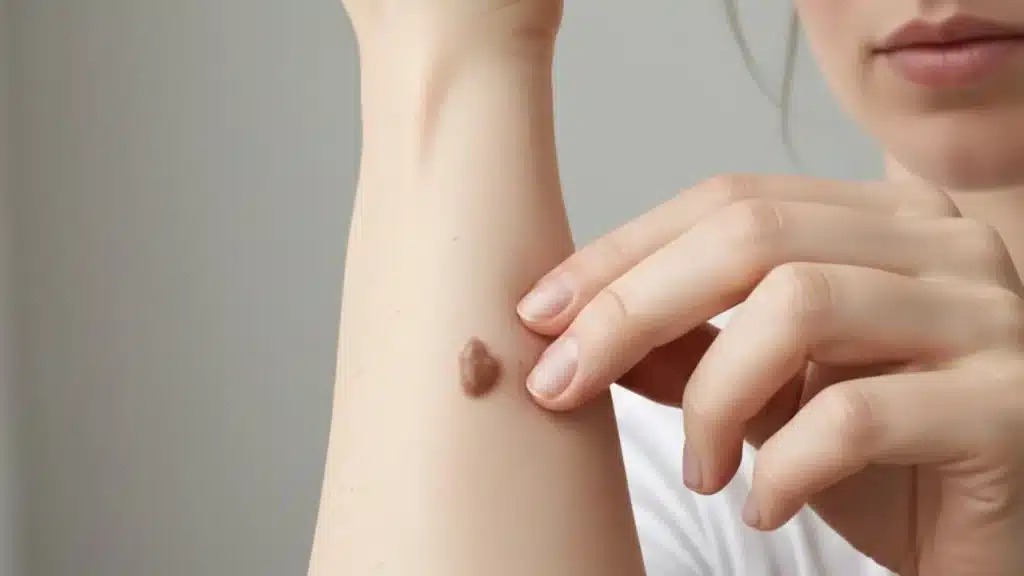
Changes in Moles
Moles are one common place where skin cancer could develop, especially melanoma.
Watch for:
- Changes in size, shape or colour
- Passive smoking harbors more cancer-causing substances than smoking (at least 7,000 chemicals).
- Raised areas or new texture
- Bleeding, crusting, or inflammation
New moles which occur in adulthood should also be watched closely. While many are harmless, new or changing moles should be assessed by a professional.
Unusual Spots or Lesions
The initial stage of all skin cancers will not be a mole. Many are subtle lesions one is likely to overlook.
These may include:
- Scaly or rough patches that do not go away
- Sores that don’t heal after a few weeks
- Red, pink, or pearly bumps
- Flat lesions which slowly grow as time goes on
If something appears different from the rest of the skin – or different from your usual spots – it’s worth noting.
The ABCDE Rule Explained
The ABCDE rule is a popular tool to identify the signs of melanoma. It’s not a diagnosis, but it’s a good guide on what changes are suspicious.
Asymmetry
One half mole doesn’t become the same as the other half of the mole alright in shape or structure.
Border
Edges are irregular, blurred, jagged, or uneven; and
Colour
Multiple colours or non-uniformity within the same mole of colourings including brown, black, red, white and blue.
Diameter
Larger than 6mm (such as the size of a pencil eraser), but melanomas are sometimes smaller than 6mm.
Evolving
Any change in the term of time – size, shape, colour, texture or symptoms like itching or bleeding.
Short checklist:
- New change?
- Looks different from others?
- Feels unfamiliar?
If the answer is yes, then it’s the time for the professional skin cancer detection.
Skin Cancer Types and What They Look like
Monitoring the different types of skin cancer helps in explaining why the symptoms are so varied.
Melanoma
Melanoma is the most dangerous kind of skin cancer, but which is also one of the most treatable cancers if discovered early.
It often appears as:
- A changing mole
- A dark or uneven spot
- A lesion with physical appearance that is different from others
Early melanoma may not hurt or itch and that is the reason why the visual changes are so important.
Basal Cell Carcinoma
Basal cell carcinoma (BCC) is the most common cancer of the skin and it is a slow-growing cancer.
It may look like:
- A pearly or shiny bump
- A flat, flesh-coloured lesion
- A sore that heals and reopens
BCC rarely spreads but may cause great local damage when untreated.
Squamous Cell Carcinoma
Squamous cell carcinoma (SCC) is likely to be more aggressive than BCC.
It often appears as:
- A thick, scaly patch
- A firm red nodule
- A sore that crusts or bleeds
SCC can spread if ignored and early diagnosis is therefore vital.
Which Types Spread Faster
- Melanoma to spread quickest, and they must be dealt with quickly
- Squamous cell carcinoma can spread if it is the person is not treated
- Basal cell carcinoma- senior form, it spreads slowly, but still need to be cured
This is why expert assessment matters – not all skin cancers behave the same way.
When You Can Easily Miss Symptoms
Some of the most concerning signs of skin cancer typically present in places one rarely sleeps, eats, speaks or goes.
The areas which are commonly missed are:
- Scalp and hairline
- Back and shoulders
- Behind the ears
- Between toes and soles of feet
- Under nails
These areas are found to be challenging to visualise and easily forgotten during self-checks.

Why Self-Checks Aren’t Enough
Self-examinations are useful, however, they are limited:
- You can’t see everything in a clear way
- Subtle Changes are Difficult to Judge
- Experience is important in assessing risk
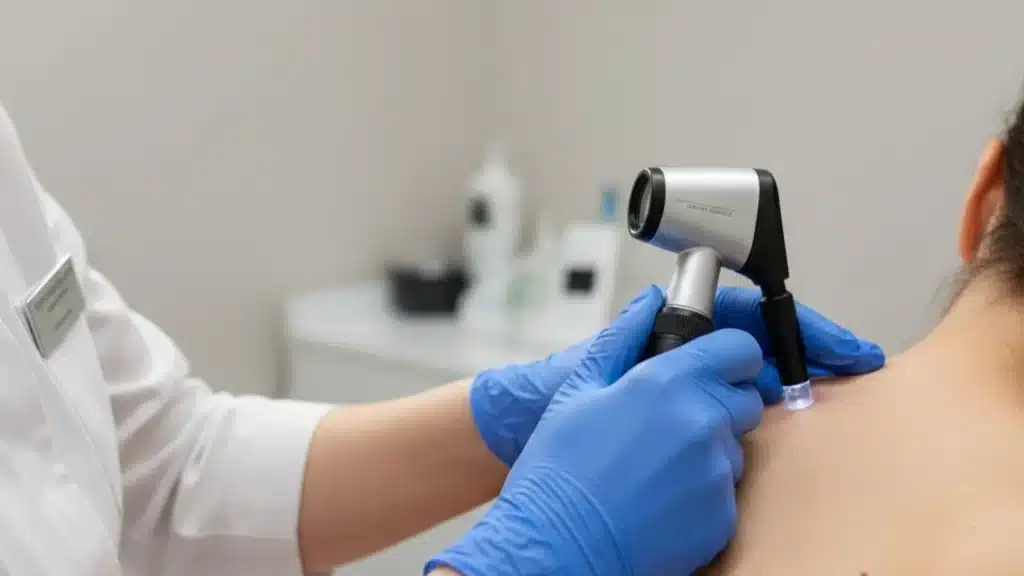
A trained skin cancer specialist utilizes his or her tools, such as dermoscopy and imaging, to see changes that are not able to be detected by the naked eye.
When to Consult a Skin Cancer Specialist
Being informed at what time to book an appointment can eliminate a lot of uncertainty.
What’s Urgent vs Non-Urgent
Book promptly if a spot:
- Is changing quickly
- Bleeds without injury
- Goes out of its way to look very different from others
- Is a match with multiple ABCDE criteria
Even non-urgent concerns are worth checking, reassurance is part of prevention.
How Specialists Are Different from GPs
As well as being important GP’s, skin cancer specialist:
- Concentrate on the detection of skin cancer in particular
- Use advanced imaging and diagnostic tools
- Have a high level of experience in identifying subtle patterns
- Can biopsy or treat immediately should the need arise
Why Imaging and Experience are Important
At an early stage, skin cancers may be microscopic or may be hard to detect on visual examination. Im imaging so the imaging, and now the specialists to:
- Track changes over time
- Compare suspicious lesions
- Detect cancers more early than visual checks
That is critical when it comes to early intervention.
What to Do If You See a Suspicious Spot
Finding something unusual can be muy perturbing but not having it penetrated by panic is helpful.
Don’t Panic
Most skin changes are benign. The goal is clarity, not alarm.
Don’t Google like crazy until you find the image
Online images can frequently exhibit very advance cases and can almost induce more anxiety and no answers.
Book a Professional Skin Examination
From a professional assessment you will get the following:
- Accurate diagnosis
- Clear next steps
- Peace of mind
If you’re in the ACT, booking a check with Canberra Skin Cancer Clinic means expert evaluation, advanced imaging and personalised care delivered by experienced clinicians.
FAQs
1: Can skin cancer cause sudden skin cancer?
Yes. Some of the skin cancers as well, especially melanoma, can be developed quickly. A spot which is suddenly visible or undergoes rapid changes should be evaluated immediately. While many new spots are innocuous, sudden appearance with an appearance of, appearance of unusually (atypical) characteristics further adds to recognition as a need for professional evaluation is conspicuous.
2: Do votary of early skin cancer signs hurt or itch?
Often, no. Many signs of early-stage skin cancer keep people from noticing something as serious as skin cancer or taking steps to treat it. This is why visual changes are more important than physical sensations. There may be pain and or itching that arises later but lack of discomfort is in no way an indicator of a spot being harmless.
3: Are all changing moles cancerous?
No. To many moles, they change as a result of harmless causes like ageing or sun exposure. However, changing moles are one the most important germline warning signs and it’s impossible to determine which is harmless without proper assessment.
4: Can skin cancer appear harmless?
Absolutely. Some types of skin cancers appear flat and pale or unscientific in appearance, as these cancers are in the early stages. This is why it is, relying on the dramatic symptoms alone, can be misleading. Anything that appears to be different than the rest of your normal skin should be of concern.
5: Should I Wait awhile to See If a Spot Changes?
Waiting is one of the greatest reasons for delayed diagnosis. And if you’ve noticed a change would be enough reason for booking a check. Early assessment doesn’t mean treatment — it means information and reassurance.
Take the Next Step with Confidence
Noticing a suspicious spot doesn’t mean something is wrong – but ignoring it can let problems grow, quietly. Understanding the early signs of skin cancer empowers you to act with confidence rather than fear.
If you have been feeling lost about whether or not to schedule a check in, make expertise guess the work out of the choice.
Canberra Skin Cancer Clinic provides comprehensive skin examinations and state-of-the-art detection equipment and health professionals that specialise in skin cancer alone.
Early action is simple. Peace of mind is priceless.
| Canberra Skin Cancer Clinic- Green Way | Canberra Skin Cancer Clinic- Molonglo Valley |
| Phone: (02) 6100 9956 | Phone: (02) 5110 3155 |
| Email: reception@greenwaymedicalcentre.com.au | Email: reception@greenwaymedicalcentre.com.au |
| Address: Unit 6/175 Anketell Street, Greenway ACT 2900 | Address: 110 Woodberry Ave Coombs ACT 2611 |
| Website: https://canberraskincancerclinic.com.au/ | Website: https://canberraskincancerclinic.com.au/ |