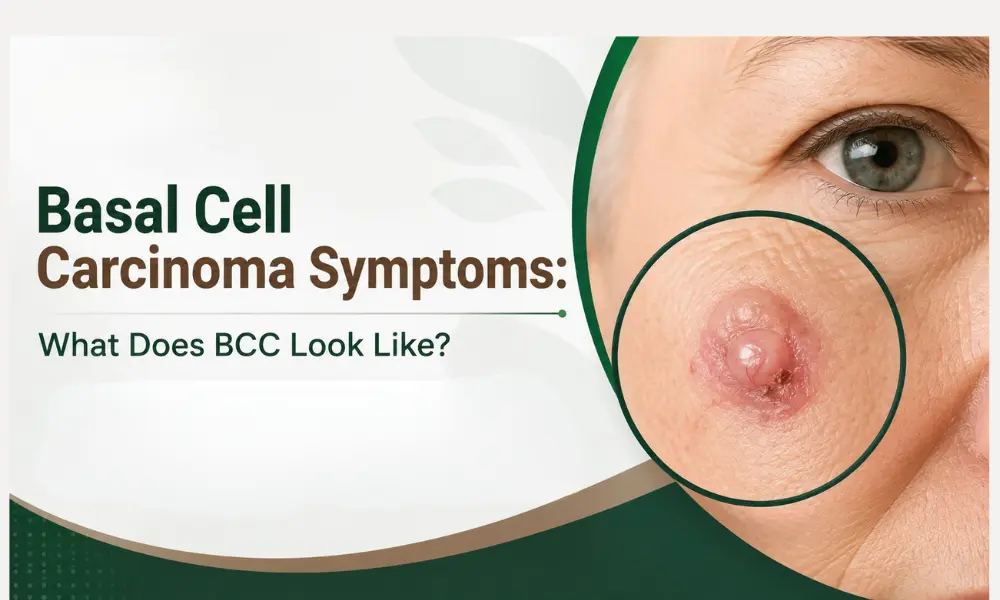
Basal Cell Carcinoma Symptoms: What Does BCC Look Like?
What Is Basal Cell Carcinoma?
Basal cell carcinoma (BCC) is the most common type of skin cancer. It develops in the basal cells, which are found in the outer layer of the skin.
BCC usually grows slowly and rarely spreads to other parts of the body. However, that does not mean it should be ignored. If left untreated, a BCC can continue growing into nearby tissue and become more difficult to remove.
BCC most commonly develops on areas that receive regular or intermittent sun exposure, particularly the face, head and neck. It can also occur on the shoulders, back, arms and legs.
Knowing the basal cell carcinoma symptoms can help you recognise a suspicious skin change and seek medical advice earlier.
What Does Basal Cell Carcinoma Look Like?
One of the tricky things about BCC is that it does not always have one distinctive appearance.
A BCC may look like:
- A pearly or shiny lump
- A pink, red or flesh-coloured growth
- A pale or pink scaly patch
- A sore that does not heal
- A spot that repeatedly crusts or bleeds
- A shiny, scar-like area
- A lesion with tiny visible blood vessels
Some BCCs can also look similar to a harmless rash, eczema, scar or other common skin condition.
This is why it is important not to rely on appearance alone when deciding whether a skin lesion is harmless.
Common Basal Cell Carcinoma Symptoms
Many BCCs cause no symptoms, particularly in their early stages. However, there are several changes you should watch for.
1. A Pearly or Shiny Lump
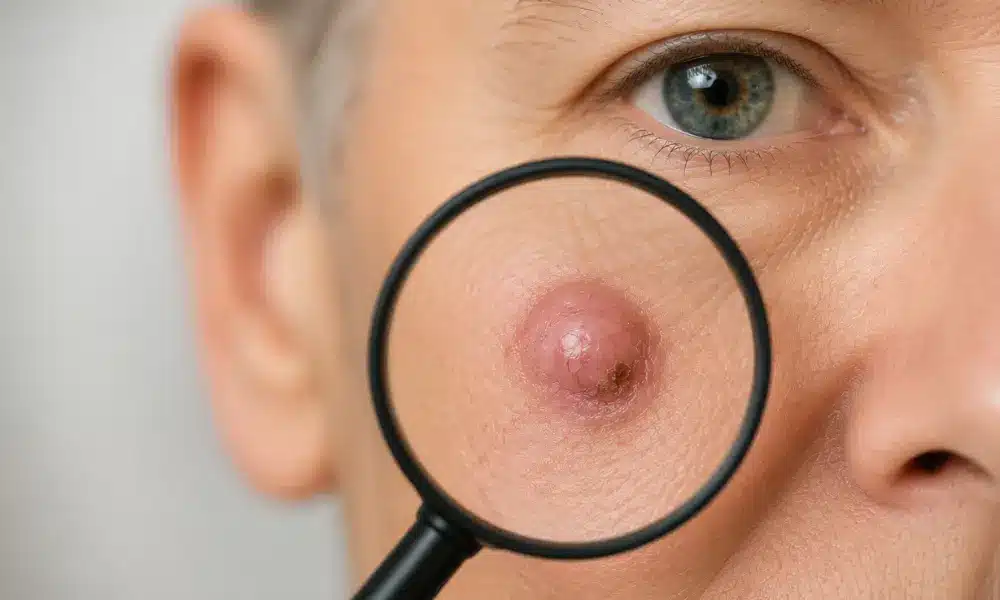
A small, raised lump that appears pearly, translucent, pink or flesh-coloured can be a sign of BCC.
It may gradually become larger over months or years.
Some lesions may have small blood vessels that are visible on the surface.
2. A Persistent Scaly or Dry Patch
BCC can sometimes appear as a flat, dry or scaly area of skin.
It may be pale pink, bright pink or reddish and can resemble a patch of irritated or dry skin.
If the area keeps returning despite moisturising or other basic care, it is worth having it assessed.
3. A Sore That Doesn’t Heal
One of the important basal cell carcinoma symptoms is a sore or wound that does not completely heal.
It may appear to improve temporarily before returning.
A persistent sore should not automatically be assumed to be BCC, but it deserves professional assessment.
4. Repeated Bleeding or Crusting
A suspicious lesion may:
- Bleed after minor contact
- Develop a crust
- Heal temporarily
- Bleed or crust again
Cancer Council Australia notes that BCC may ulcerate, bleed or fail to completely heal.
5. A Scar-Like Area
Some less common BCCs can look like a firm, pale or shiny scar even when there has been no previous injury or surgery in that area.
Because this appearance can be subtle, any unexplained scar-like change that persists should be checked.
6. Itching, Irritation or Inflammation
Although many BCCs do not cause symptoms, some lesions may become itchy, inflamed or irritated.
Symptoms alone cannot confirm whether a lesion is cancerous, so a medical examination is important.
Where Does Basal Cell Carcinoma Usually Appear?
BCC can develop anywhere on the body, but it is particularly common on areas exposed to sunlight.
These include:
- Face
- Nose
- Ears
- Scalp
- Neck
- Shoulders
- Back
- Arms
- Legs
The face and other frequently sun-exposed areas deserve particular attention because cumulative UV exposure is a major risk factor for skin cancer.
What Does BCC Look Like on the Face?
Because BCC commonly occurs on the face, people often notice a suspicious lesion while washing, shaving, applying skincare or looking in the mirror.
A basal cell carcinoma on the face may appear as:
- A shiny pink or pearly bump
- A persistent red patch
- A sore that repeatedly heals and reopens
- A small bleeding spot
- A crusted lesion
- A shiny or scar-like patch
Even a very small lesion should be checked if it is persistent or changing.
Early assessment can be particularly important on the face because untreated BCC may progressively invade surrounding tissue.
Does Basal Cell Carcinoma Hurt?
Usually, BCC does not cause pain, particularly in the early stages.
However, some lesions can become itchy, inflamed, ulcerated, irritated or bleed.
It is important not to wait for a skin lesion to become painful before getting it checked. Cancer Council Australia notes that skin cancers rarely hurt and are more often noticed through visible or textural changes.
What Causes Basal Cell Carcinoma?
The main cause of BCC is damage from ultraviolet (UV) radiation, primarily from the sun.
Repeated UV exposure can damage the DNA in skin cells and contribute to the development of skin cancer.
Risk can be increased by factors such as:
- Long-term sun exposure
- Frequent sunburn
- Fair or sun-sensitive skin
- Increasing age
- Previous skin cancer
- Outdoor work or activities
- Tanning bed exposure
- A weakened immune system
- Certain medical or environmental exposures
Australia experiences high levels of UV radiation, and unprotected skin can be damaged throughout much of the year.
Is Basal Cell Carcinoma Dangerous?
BCC is generally considered the least aggressive of the three main types of skin cancer, and it very rarely spreads to distant parts of the body.
However, BCC can still cause significant local damage if it is allowed to grow untreated.
A larger or deeper BCC may invade surrounding tissue and make treatment more complex. Early diagnosis can therefore help prevent a small lesion from becoming a more extensive problem.
How Is Basal Cell Carcinoma Diagnosed?
If a doctor is concerned about a skin lesion, they will examine it closely.
A dermatoscope may be used to magnify the lesion and examine features that cannot be seen clearly with the naked eye.
If BCC is suspected, the doctor may recommend a skin biopsy. A small sample of the lesion is taken and examined in a laboratory to determine whether cancer cells are present.
A biopsy is important because several harmless skin conditions can look similar to BCC.
How Is Basal Cell Carcinoma Treated?
Treatment depends on several factors, including:
- Type of BCC
- Size
- Location
- Depth
- Whether it is a new or recurrent cancer
- Overall health
- Previous treatment
Treatment options may include surgical excision, Mohs micrographic surgery, curettage and electrodesiccation, cryotherapy, topical treatments, photodynamic therapy or radiotherapy in selected circumstances.
For many BCCs, surgery is an effective treatment. More specialised approaches may be considered when the lesion is in a sensitive location, has high-risk features or has returned after previous treatment.
When Should You See a Skin Cancer Doctor?
You should arrange a professional skin assessment if you notice:
- A new lump or growth
- A pearly or shiny spot
- A sore that does not heal
- A spot that repeatedly bleeds
- A persistent scaly patch
- A lesion that keeps crusting
- An unexplained scar-like area
- A spot that changes in size, shape or texture
- A skin change that looks different from your other spots
Cancer Council Australia recommends seeing a doctor when you notice something new or a change in an existing skin lesion.
You do not need to wait until a spot becomes painful.
How Can You Check Your Skin for BCC?
Regular self-checks can help you become familiar with what is normal for your skin.
When checking yourself:
- Stand in a well-lit room.
- Examine your face, neck and ears.
- Check your arms, hands and shoulders.
- Look carefully at your chest and abdomen.
- Check your legs and feet.
- Use a mirror to inspect your back and scalp.
- Ask someone you trust to help with areas that are difficult to see.
Look for new spots or changes in existing lesions, including changes in size, shape, colour or texture.
Cancer Council Australia recommends getting to know your skin so that you can recognise changes more easily.
Can Basal Cell Carcinoma Be Prevented?
You cannot eliminate your lifetime risk of BCC, but reducing UV exposure can help protect your skin.
Important sun-protection habits include:
- Use broad-spectrum sunscreen as directed.
- Wear protective clothing.
- Wear a broad-brimmed hat.
- Seek shade where possible.
- Avoid unnecessary exposure when UV levels are high.
- Avoid tanning beds.
- Regularly check your skin.
More than 95% of skin cancers in Australia are associated with exposure to UV radiation, making sun protection an important part of skin cancer prevention.
Why Regular Skin Checks Matter
A BCC can develop slowly and may not cause obvious symptoms.
This means that waiting until a lesion becomes large, painful or heavily ulcerated is not a good approach.
Regular professional skin checks can help identify suspicious lesions that may not be easy to recognise yourself. During a skin examination, a doctor can assess unusual areas more closely using tools such as dermoscopy and recommend a biopsy if required.
Canberra Skin Cancer Clinic provides skin cancer assessment and encourages patients to seek professional advice when they notice new or suspicious skin changes. The clinic also notes that BCC commonly presents as a shiny or pearly bump, a persistent sore, a scar-like patch or an area with tiny visible blood vessels.
Basal Cell Carcinoma Symptoms: What to Remember
The most important thing to remember is that BCC does not always look like a typical “skin cancer.”
It may be a tiny pearly lump, a persistent scaly patch, a sore that does not heal or a spot that repeatedly bleeds and crusts.
If something on your skin is new, persistent, changing or simply looks different from your other spots, it is worth getting it checked.
Early assessment can help identify skin cancer before it becomes more extensive and difficult to treat.
If you have noticed a suspicious skin change, consider booking a professional skin cancer check in Canberra.
Frequently Asked Questions About Basal Cell Carcinoma Symptoms
1. What are the most common basal cell carcinoma symptoms?
Common signs include a pearly or shiny lump, a pink or red scaly patch, a sore that does not heal, repeated bleeding or crusting, and sometimes a scar-like area. BCC may also have no obvious symptoms.
2. What does basal cell carcinoma look like?
BCC can look like a pearly, pink or flesh-coloured bump, a shiny or scaly patch, a persistent sore, or a scar-like area. It can vary considerably in appearance.
3. Can basal cell carcinoma look like a pimple?
Yes, some BCCs can initially resemble a small pimple or bump. If a spot does not disappear, keeps returning, grows or bleeds, it should be professionally assessed.
4. Is basal cell carcinoma itchy or painful?
BCC is often symptom-free, but some lesions can become itchy, inflamed, irritated or bleed. Pain is not required for a lesion to be suspicious.
5. Can basal cell carcinoma heal by itself?
A BCC may temporarily crust or appear to heal, but this does not mean the cancer has gone away. A sore that repeatedly heals and returns should be assessed by a doctor.
6. Where does BCC usually occur?
BCC commonly develops on sun-exposed areas such as the face, head and neck, although it can occur elsewhere on the body.
7. Is basal cell carcinoma dangerous?
BCC rarely spreads to distant parts of the body, but untreated lesions can grow into nearby tissue and cause significant local damage. Early diagnosis and treatment are important.
8. How is BCC diagnosed?
A doctor will examine the suspicious area, often using a dermatoscope. A biopsy may be performed to confirm whether the lesion is BCC.
9. Can basal cell carcinoma be treated?
Yes. BCC is highly treatable, and treatment may include surgery or other approaches depending on the type, size and location of the cancer.
10. When should I get a skin check in Canberra?
You should arrange a skin check if you notice a new or changing lesion, a sore that does not heal, a spot that bleeds or a persistent unusual skin change. Regular checks may also be appropriate depending on your individual skin cancer risk. Canberra Skin Cancer Clinic advises patients to seek assessment when they notice suspicious skin changes.
Final Takeaway
Basal cell carcinoma symptoms can be subtle. A small pearly bump, scaly patch or sore that refuses to heal may seem harmless, but persistent or changing skin lesions deserve attention.
If you are unsure about a spot, don’t try to diagnose it yourself. A professional skin examination can help determine whether further investigation, such as a biopsy, is needed.
For people in Canberra, arranging a skin check when you notice a suspicious change is a simple step towards earlier detection and appropriate treatment.
Book a skin check with Canberra Skin Cancer Clinic if you have concerns about a suspicious or sun-damaged spot.
| Canberra Skin Cancer Clinic- Green Way | Canberra Skin Cancer Clinic- Molonglo Valley |
| Phone: (02) 51046409 | Phone: (02) 51046409 |
| Email: reception@greenwaymedicalcentre.com.au | Email: reception@greenwaymedicalcentre.com.au |
| Address: Unit 6/175 Anketell Street, Greenway ACT 2900 | Address: 110 Woodberry Ave Coombs ACT 2611 |
| Website: https://canberraskincancerclinic.com.au/ | Website: https://canberraskincancerclinic.com.au/ |