What Is Mohs Surgery?
Mohs surgery, also called Mohs micrographic surgery (MMS), is a specialized surgical technique used to remove certain types of skin cancer while preserving as much healthy surrounding tissue as possible.
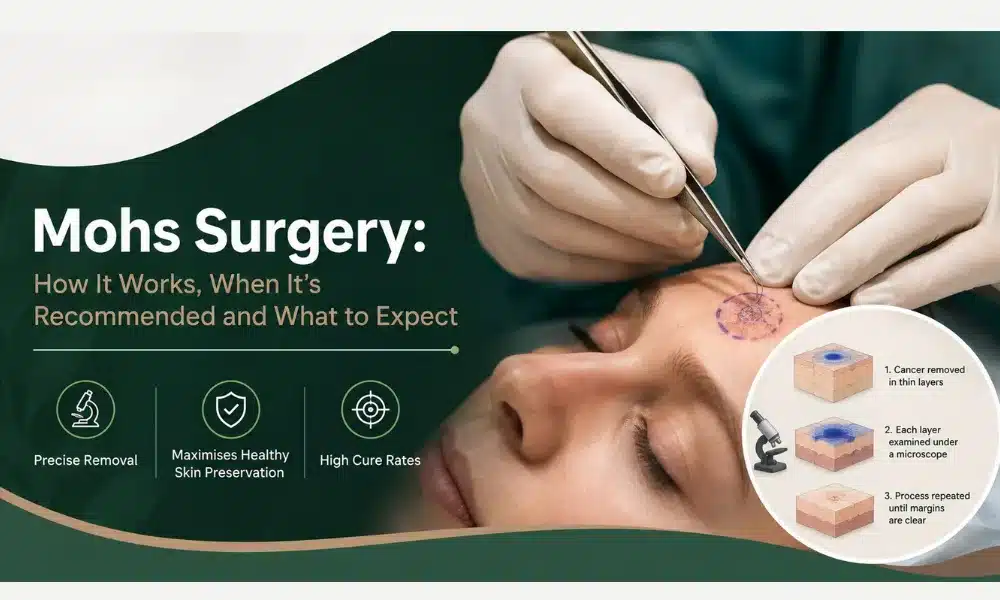
Unlike conventional excision, where the entire tumor is removed and the tissue is generally assessed after the procedure, Mohs surgery involves removing the cancer in carefully controlled stages. Each layer is examined under a microscope before another layer is removed.
This allows the surgeon to check the edges of the removed tissue during the procedure and continue removing tissue only where cancer cells remain.
The goal is simple: remove the skin cancer completely while conserving as much healthy skin as possible.
How Does Mohs Surgery Work?
One of the key features of Mohs surgery is its layer-by-layer approach.
Although the exact process can vary depending on the cancer and surgical setting, it generally involves the following steps.
1. The Area Is Examined and Prepared
Before the procedure begins, the surgeon identifies the skin cancer and marks the treatment area. The skin is cleaned and prepared for surgery.
2. Local Anaesthetic Is Given
Mohs surgery is commonly performed using local anesthetic. This numbs the treatment area so that you remain awake but should not feel the surgical removal itself.
3. The Visible Cancer Is Removed
The surgeon carefully removes the visible tumor along with a small amount of surrounding tissue.
4. The Tissue Is Examined
The removed tissue is processed and examined under a microscope. The surgeon checks the edges of the specimen to determine whether any cancer cells remain.
5. Additional Tissue Is Removed if Needed
If cancer cells are still present at the edges, another thin layer is removed from the specific area where cancer remains.
This process is repeated until the examined margins are clear.
6. The Wound Is Repaired
Once the cancer has been completely removed, the resulting wound is assessed. Depending on its size, location, and depth, it may be closed with stitches or repaired using another reconstructive technique.
Why Is Mohs Surgery Different From Standard Skin Cancer Surgery?
Traditional surgical excision usually involves removing the skin cancer with a predetermined margin of surrounding tissue. The tissue is then sent for pathological examination.
Mohs surgery differs because the tissue margins are examined during the procedure, allowing the surgeon to identify and remove remaining cancer cells more precisely.
This tissue-sparing approach can be particularly valuable in areas where preserving healthy skin is important for appearance or function.
The Cancer Council Australia guidelines have identified situations where Mohs micrographic surgery may be considered, including some basal cell carcinomas with poorly defined borders, aggressive histological subtypes, previous treatment failure or recurrence, lesions in high-risk facial areas, and larger facial lesions where tissue preservation would provide clinical value.
When Is Mohs Surgery Recommended?
Mohs surgery is not necessary for every skin cancer. The most appropriate treatment depends on the type of cancer, its size, location, behavior, previous treatment, and other individual factors.
Mohs surgery may be considered for certain:
- Basal cell carcinomas (BCC)
- Recurrent skin cancers
- Skin cancers with poorly defined borders
- Aggressive or infiltrative tumours
- Cancers located in cosmetically or functionally important areas
- Larger tumours where preserving healthy tissue is particularly important
- Tumours that have returned after previous treatment
Mohs Surgery for Skin Cancer on the Face
The face contains many structures where removing unnecessary healthy tissue can affect appearance or function.
For cancers around areas such as the nose, eyelids, lips, ears, or other parts of the face, tissue preservation may be an important consideration.
In selected cases, Mohs surgery can help the surgeon remove the cancer while limiting the amount of healthy tissue removed.
Is Mohs Surgery Used for Basal Cell Carcinoma?
Yes. Basal cell carcinoma (BCC) is one of the skin cancers for which Mohs surgery may be considered, particularly when the tumor has high-risk characteristics.
Examples can include recurrent BCC, cancers in high-risk facial locations, poorly defined tumors, and certain aggressive subtypes.
BCC is the most common type of skin cancer in Australia. While it generally grows slowly and rarely spreads to distant organs, untreated BCC can continue growing into surrounding tissue.
The decision about whether Mohs surgery is appropriate should be made after assessing the individual cancer.
Is Mohs Surgery Used for Squamous Cell Carcinoma?
Mohs surgery may also be considered for selected squamous cell carcinomas (SCC), particularly those with high-risk features or those occurring in areas where tissue preservation is important.
SCC can be more aggressive than BCC and may spread if left untreated. Treatment decisions depend on factors including the tumor’s location, size, depth, recurrence, and other pathological features.
A skin cancer specialist can assess the lesion and determine whether Mohs surgery, standard excision, or another treatment approach is more appropriate.
What Are the Benefits of Mohs Surgery?
The main potential benefits of Mohs surgery include:
Precise Cancer Removal
Because the tissue margins are examined during the procedure, the surgeon can identify areas where cancer remains and target those areas specifically.
Preservation of Healthy Tissue
Only additional tissue from areas where cancer is detected needs to be removed. This can help preserve healthy surrounding skin.
Important for Visible Areas
When a tumor is located on the face or another sensitive area, preserving healthy tissue can be particularly important for both appearance and function.
Useful for Some Recurrent Skin Cancers
Mohs surgery can be considered for selected skin cancers that have returned following previous treatment.
High Level of Margin Control
The technique allows the surgeon to assess the surgical margins during treatment rather than relying solely on a later pathology result.
What Should You Expect Before Mohs Surgery?
Before surgery, your doctor will assess the skin cancer and discuss the recommended treatment.
You may be asked about:
- Your general health
- Previous skin cancer treatments
- Medications you take
- Any allergies
- Previous problems with local anaesthetic
- Blood-thinning medications
- The location and history of the skin cancer
Make sure your doctor knows about all medications and supplements you take. Do not stop prescribed medication unless your doctor specifically tells you to.
Your doctor should also explain the procedure, expected wound size, possible reconstruction, and aftercare.
What Happens on the Day of Mohs Surgery?
Mohs surgery is generally performed as an outpatient procedure, meaning you may be able to return home the same day.
The procedure can take longer than a standard skin cancer excision because the tissue needs to be processed and examined between stages.
You may, therefore, spend several hours at the clinic, depending on the following:
- The size of the cancer
- How many layers need to be removed
- How quickly the tissue can be processed
- The complexity of wound repair
It can be helpful to bring something to read or use while waiting between stages.
Is Mohs Surgery Painful?
The treatment area is numbed with local anesthetic before surgery, so you should not feel sharp pain during the removal of the cancer.
You may notice pressure, movement, or some pulling sensations during the procedure.
Afterwards, the area can feel tender, swollen, or uncomfortable as the anesthetic wears off. Your doctor will provide wound-care instructions and advice about managing discomfort.
What Happens After Mohs Surgery?
After the cancer has been completely removed, the surgeon will decide how best to manage the wound.
Depending on the size and location, options may include:
- Closing the wound with stitches
- Allowing a smaller wound to heal naturally
- Using a skin flap
- Using a skin graft
- Referral for additional reconstruction when required
The appropriate approach depends on the individual wound.
Your doctor will explain how to keep the area clean, how to change dressings, and when you need a follow-up appointment.
Mohs Surgery Recovery
Recovery varies from person to person and depends largely on the size and location of the wound and the type of repair required.
During recovery, you may experience:
- Mild swelling
- Bruising
- Tenderness
- Temporary redness
- Tightness around the wound
- A visible scar while the area heals
Follow your doctor’s wound-care instructions carefully.
Avoid strenuous activities when advised, particularly if they could cause bleeding or place tension on the wound.
Contact your medical team if you experience unexpected bleeding, increasing pain, significant swelling, signs of infection, or other concerning changes.
Will Mohs Surgery Leave a Scar?
Any procedure that cuts the skin can result in a scar. However, one of the potential advantages of Mohs surgery is that it aims to preserve healthy tissue while removing the cancer.
The final appearance of the scar depends on factors such as the following:
- Size of the tumour
- Location
- Depth of removal
- Type of wound closure
- Individual healing
- Skin characteristics
Scars can continue to change and mature for months after surgery.
Your doctor can explain what type of scar you may expect and discuss appropriate scar-care options once the wound has healed.
How Successful Is Mohs Surgery?
Mohs surgery is designed to achieve complete removal of selected skin cancers while conserving surrounding healthy tissue.
However, no surgical procedure can guarantee that another skin cancer will never develop elsewhere on the body.
People who have had skin cancer remain at increased risk of developing additional skin cancers and should continue appropriate skin checks and sun protection. Cancer Council Australia recommends ongoing follow-up after skin cancer treatment, with the frequency depending on the individual’s risk and previous cancer.
Mohs Surgery vs Standard Excision
Both Mohs surgery and standard surgical excision can be effective treatments for skin cancer, but they are used in different circumstances.
| Mohs Surgery | Standard Excision |
| Tissue is removed in stages | Cancer is removed with a planned margin |
| Margins are checked during the procedure | Tissue is generally assessed after removal |
| Designed to preserve healthy tissue | May remove a wider predetermined margin |
| Particularly useful for selected high-risk cancers | Suitable for many straightforward skin cancers |
| Can be valuable in cosmetically sensitive areas | Commonly used for many localised skin cancers |
The best option is not necessarily the most advanced-sounding procedure. It is the treatment that is appropriate for your specific skin cancer.
Is Mohs Surgery Right for You?
If you have been diagnosed with skin cancer, it is natural to wonder whether Mohs surgery is the best option.
Your doctor will consider:
- The type of skin cancer
- Tumour size
- Tumour location
- Whether the edges are clearly defined
- Whether the cancer has returned
- Histological features
- Previous treatments
- The importance of preserving surrounding tissue
A detailed assessment is essential before deciding on treatment.
Canberra Skin Cancer Clinic provides skin cancer assessment and treatment, including surgical management where appropriate. The clinic’s information also notes Mohs surgery as a tissue-sparing option for selected skin cancers, particularly where cosmetic or functional preservation is important.
Why Early Skin Cancer Detection Matters
Skin cancers can become more difficult to treat as they grow deeper or spread into surrounding tissue.
Cancer Council Australia recommends becoming familiar with your own skin and seeing a doctor if you notice a new lesion or changes in the size, shape, or color of an existing lesion.
Look out for:
- A new lump or growth
- A sore that does not heal
- A spot that repeatedly bleeds
- A rough or scaly patch that keeps returning
- A mole or lesion that changes
- A spot that looks noticeably different from others
If something on your skin does not look or feel right, it is better to have it assessed rather than waiting for it to become more obvious.
Protect Your Skin After Skin Cancer Treatment
Having skin cancer treated does not mean you can stop worrying about sun exposure.
More than 95% of skin cancers are caused by exposure to UV radiation, and Australia experiences high levels of UV radiation.
Protect your skin by:
- Using broad-spectrum sunscreen
- Wearing protective clothing
- Wearing a broad-brimmed hat
- Seeking shade when possible
- Avoiding unnecessary exposure when UV levels are high
- Checking your skin regularly
Good sun protection can help reduce further UV-related damage.
Final Thoughts
Mohs surgery is a specialized technique designed to remove certain skin cancers while preserving as much healthy surrounding tissue as possible.
It may be particularly useful for selected cancers that are recurrent, difficult to define, aggressive, or located in areas where preserving tissue is important.
If you have been diagnosed with skin cancer or have a suspicious lesion, speak with a qualified skin cancer doctor about your treatment options. The right procedure depends on your individual diagnosis, the location of the cancer, and its risk characteristics.
For patients in Canberra, a professional skin cancer assessment can help determine the most appropriate next step.
If you have noticed a new or changing skin lesion, arrange a skin check rather than waiting for it to worsen.
Frequently Asked Questions About Mohs Surgery
1. What is Mohs surgery?
Mohs surgery is a specialized technique for removing certain skin cancers layer by layer. Each layer is examined during the procedure so that the surgeon can identify and remove remaining cancer cells while preserving as much healthy tissue as possible.
2. What types of skin cancer can be treated with Mohs surgery?
Mohs surgery is commonly considered for selected basal cell carcinomas and some squamous cell carcinomas, particularly when the cancer is recurrent, aggressive, poorly defined, or located in a cosmetically or functionally important area.
3. Is Mohs surgery better than standard excision?
Not necessarily. Mohs surgery and standard excision are different techniques suited to different situations. Mohs may offer advantages for selected high-risk skin cancers where precise margin control and tissue preservation are particularly important.
4. Is Mohs surgery painful?
The treatment area is numbed with local anesthetic, so you should not feel sharp pain during the procedure. Some tenderness or discomfort can occur after the anesthetic wears off.
5. How long does Mohs surgery take?
The procedure time varies. Because each tissue layer may need to be examined before the next layer is removed, patients may spend several hours at the clinic.
6. Will I need stitches after Mohs surgery?
Not always. Depending on the size and location of the wound, it may be closed with stitches, repaired with a flap or graft, or allowed to heal naturally.
7. Does Mohs surgery leave a scar?
Any surgery involving the skin can leave a scar. The appearance depends on the size and location of the wound, the repair method, and how your skin heals.
8. How long does it take to recover from Mohs surgery?
Recovery varies depending on the wound and repair. Your doctor will provide personalized instructions about wound care, physical activity, and follow-up.
9. Can skin cancer come back after Mohs surgery?
Mohs surgery is designed to remove the identified cancer, but no treatment guarantees that skin cancer will never recur or that a new skin cancer will not develop elsewhere. Continued skin checks are important after treatment.
10. When should I see a skin cancer doctor?
You should arrange an assessment if you notice a new or changing lesion, a sore that does not heal, a spot that repeatedly bleeds, or a rough, scaly, or unusual area of skin. Early assessment can help identify skin cancer before it becomes more extensive.
Book a skin check with Canberra Skin Cancer Clinic if you have concerns about a suspicious or sun-damaged spot.
| Canberra Skin Cancer Clinic- Green Way | Canberra Skin Cancer Clinic- Molonglo Valley |
| Phone: (02) 51046409 | Phone: (02) 51046409 |
| Email: reception@greenwaymedicalcentre.com.au | Email: reception@greenwaymedicalcentre.com.au |
| Address: Unit 6/175 Anketell Street, Greenway ACT 2900 | Address: 110 Woodberry Ave Coombs ACT 2611 |
| Website: https://canberraskincancerclinic.com.au/ | Website: https://canberraskincancerclinic.com.au/ |