
Squamous Cell Carcinoma Canberra residents face represents the second most common form of skin cancer in Australia, yet many people don’t fully understand what it is, how to identify it, or what treatment options are available. Squamous cell carcinoma (SCC) develops in the squamous cells, the thin, flat cells that form the outer layer of your skin. If you’ve noticed an unusual lesion, bump, or patch on your skin, understanding Squamous Cell Carcinoma Canberra causes, signs, and treatment options can be lifesaving.
The warm Australian climate and the strong UV radiation in Canberra make skin cancer screening particularly important for our community. At Canberra Skin Cancer Clinic, we specialize in early detection and treatment of squamous cell carcinoma, helping patients achieve the best possible outcomes. This comprehensive guide covers everything you need to know about Squamous Cell Carcinoma Canberra and why professional diagnosis and treatment matter.
Understanding Squamous Cell Carcinoma
What Is Squamous Cell Carcinoma?
Squamous Cell Carcinoma Canberra cases occur when malignant cells develop in the squamous epithelial cells of the skin. These flat cells make up approximately 90% of the epidermis (the outer layer of skin), which is why squamous cell carcinoma is relatively common compared to other skin cancers.
Unlike melanoma, which tends to be more aggressive, Squamous Cell Carcinoma Canberra generally grows slowly and is less likely to spread to other parts of the body, but this doesn’t mean it should be ignored. Early detection and appropriate treatment significantly improve outcomes and can prevent serious complications.
Types of Squamous Cell Carcinoma
Cutaneous SCC: This is the most common type of Squamous Cell Carcinoma Canberra, occurring on sun-exposed areas of the skin. It typically grows slowly and responds well to treatment.
In Situ SCC (Bowen’s Disease): This is an early-stage form where cancer cells are present but haven’t invaded deeper skin layers. Squamous Cell Carcinoma Canberra at this stage is highly treatable.
Invasive SCC: When cancer cells penetrate deeper into the dermis and subcutaneous tissue, it’s classified as invasive. While still generally manageable, invasive Squamous Cell Carcinoma Canberra requires prompt, professional treatment.
High-Risk SCC: Certain factors can make Squamous Cell Carcinoma Canberra more aggressive, including location (ear, lip, genitals), size, depth, and immunosuppression.
Risk Factors for Squamous Cell Carcinoma in Canberra
UV Exposure and Canberra’s Climate
Canberra’s geographic location and altitude result in intense UV radiation exposure. Australia experiences higher UV index levels than most other countries at similar latitudes, making sun protection critical in our region. Cumulative UV exposure over a lifetime significantly increases the risk of Squamous Cell Carcinoma Canberra.
People who spend considerable time outdoors, farmers, construction workers, gardeners, and outdoor enthusiasts, face elevated risk. Even brief, intense sun exposure can damage skin cells, particularly if it results in sunburns during critical years.
Age and Gender
Squamous Cell Carcinoma Canberra predominantly affects people over 50, though it can occur at any age. Men are diagnosed more frequently than women, likely due to greater occupational outdoor exposure and lower rates of regular skin monitoring.
Fair Skin and Genetic Factors
Individuals with fair skin, light hair, and light eyes, particularly those of Celtic or Northern European descent, are at significantly higher risk for Squamous Cell Carcinoma Canberra. Fair skin contains less melanin, which provides natural UV protection.
Previous Skin Cancer
If you’ve previously had basal cell carcinoma, melanoma, or another Squamous Cell Carcinoma Canberra, your risk of developing additional skin cancers increases substantially.
Immunosuppression
Organ transplant recipients, people with HIV/AIDS, and those taking immunosuppressive medications face dramatically increased risk of Squamous Cell Carcinoma Canberra. These individuals should undergo more frequent skin screening.
Chronic Inflammation
Persistent wounds, scars, burns, or chronic skin conditions like lichen planus can lead to Squamous Cell Carcinoma Canberra development.
Identifying Squamous Cell Carcinoma: Signs and Symptoms
Appearance of Squamous Cell Carcinoma
Squamous Cell Carcinoma Canberra presents in various ways, making vigilance essential:
Firm, red nodules: A raised, firm bump with a reddish or pink appearance is a classic presentation of Squamous Cell Carcinoma Canberra.
Scaly patches: Thick, crusty, or scaly areas that don’t respond to moisturizers or ointments may indicate SCC.
Ulcerated lesions: Bleeding or oozing lesions that don’t heal are characteristic of Squamous Cell Carcinoma Canberra.
Wart-like growths: Horny, protrusion-like growths (keratotic growths) can be manifestations of SCC.
Flat patches: Bowen’s disease presents as flat, scaly patches that are often reddish-brown and may itch or bleed easily.
Lip lesions: Squamous Cell Carcinoma Canberra on the lip may appear as persistent ulceration, thickening, or color change in the vermillion border.
Common Locations for Squamous Cell Carcinoma
Sun-exposed areas: Face, ears, neck, scalp, hands, and forearms are most common. Lip: The vermillion (lip edge) is a high-risk location. Genitals: Though less common, SCC here tends to be more aggressive. Areas of previous injury: Scars and chronic wounds are susceptible.
The Importance of Professional Diagnosis
Why You Shouldn’t Self-Diagnose
While you should monitor your skin regularly using the ABCDE method (Asymmetry, Border irregularity, Color variation, Diameter >6mm, Evolving/changing), professional diagnosis is essential. Squamous Cell Carcinoma Canberra can mimic benign conditions like warts, eczema, or actinic keratosis. Conversely, some harmless lesions might raise unnecessary concern.
A trained dermatologist at Canberra Skin Cancer Clinic can:
- Perform detailed visual examination
- Use dermoscopy for enhanced visualization
- Perform biopsies when necessary
- Determine the depth and type of lesion
- Assess risk factors specific to your presentation
Dermoscopic Examination
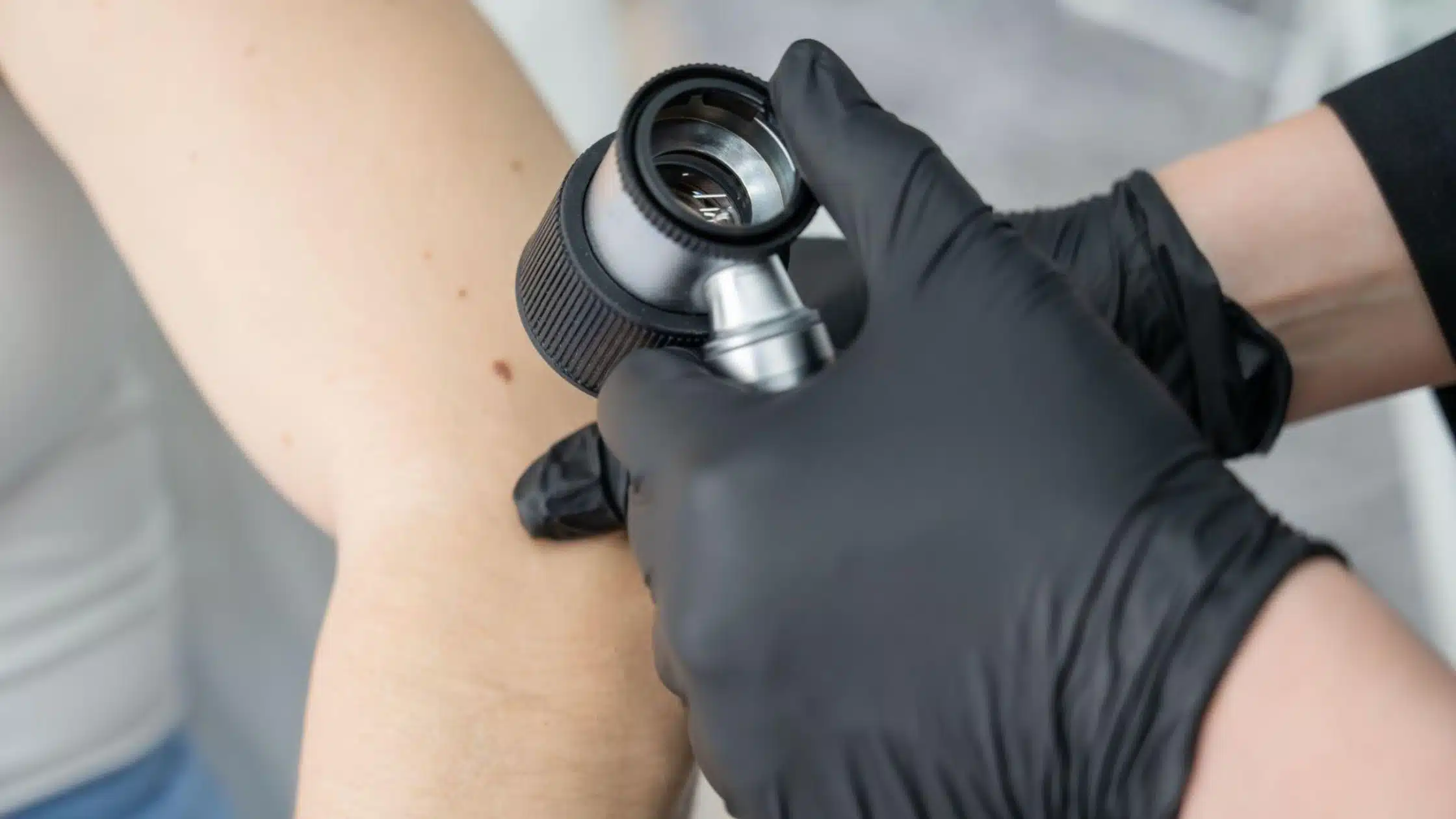
Dermoscopy is a non-invasive technique using a specialized magnifying device that allows dermatologists to examine skin at a cellular level. This tool significantly improves diagnostic accuracy for Squamous Cell Carcinoma Canberra.
Biopsy and Pathology
If a lesion is suspected to be Squamous Cell Carcinoma Canberra, a biopsy (removing a small tissue sample) is typically performed. This tissue is examined under a microscope to confirm diagnosis, determine the type of SCC, assess depth, and identify any concerning features that guide treatment planning.
Diagnosis Procedures at Canberra Skin Cancer Clinic
Complete Skin Check
Our dermatologists perform thorough head-to-toe examinations to identify any concerning lesions. This comprehensive approach ensures we don’t miss early-stage Squamous Cell Carcinoma Canberra.
Digital Dermoscopy
We use advanced digital dermoscopy and imaging technology for precise examination and documentation of skin lesions, allowing us to track changes over time.
Biopsy Services
When biopsy is indicated for suspected Squamous Cell Carcinoma Canberra, our clinic performs this procedure with minimal discomfort. Results guide our treatment recommendations.
Treatment Options for Squamous Cell Carcinoma Canberra
Surgical Excision
Surgical excision, complete removal of the lesion and surrounding tissue, is the gold standard treatment for Squamous Cell Carcinoma Canberra. This approach:
- Removes the entire lesion with clear margins
- Provides tissue for detailed pathological examination
- Offers excellent cure rates (95%+ for most lesions)
- Allows assessment of lesion depth and aggressiveness
Mohs Micrographic Surgery
For high-risk Squamous Cell Carcinoma Canberra (large, recurring, or in cosmetically sensitive areas), Mohs surgery offers optimal outcomes. This specialized technique involves precise layer-by-layer removal and microscopic examination of margins, maximizing cancer removal while minimizing healthy tissue damage.
Topical Treatments
For early-stage, superficial Squamous Cell Carcinoma Canberra or actinic keratosis:
- Imiquimod: Stimulates immune response against cancerous cells
- 5-Fluorouracil (5-FU): Chemotherapy cream that destroys malignant cells
- Tretinoin: Topical retinoid for certain early lesions
Radiation Therapy
For patients who cannot tolerate surgery or have inoperable Squamous Cell Carcinoma Canberra, radiation therapy may be recommended. This is particularly useful for large lesions or those in functionally important areas.
Other Treatment Modalities
Electrodessication and Curettage: Removal using scraping and controlled burning, suitable for small, low-risk lesions. Cryotherapy: Freezing with liquid nitrogen, effective for some superficial lesions. Laser Therapy: Used selectively for specific types of Squamous Cell Carcinoma Canberra.
What to Expect During Treatment
Before Your Treatment
- Discuss all treatment options with your dermatologist
- Clarify expectations regarding scarring and recovery
- Ask about anesthesia and pain management
- Arrange transportation if sedation is used
- Avoid blood-thinning medications as directed
During Treatment
Most Squamous Cell Carcinoma Canberra treatments are performed under local anesthesia as outpatient procedures. You’ll remain awake and comfortable while our team carefully removes the lesion.
After Treatment
Recovery varies by treatment type:
- Wound care instructions will be provided
- Most patients return to normal activities within days
- Strenuous activity may need restriction temporarily
- Follow-up appointments ensure proper healing
FAQs
Q: Is Squamous Cell Carcinoma Canberra curable?
Yes, Squamous Cell Carcinoma Canberra is highly curable when detected and treated early. Cure rates exceed 95% for most localized lesions. Early detection makes all the difference.
Q: Will I have a visible scar after treatment for Squamous Cell Carcinoma Canberra?
Scarring depends on lesion size, location, and treatment method. Our team uses techniques to minimize scarring while ensuring complete cancer removal. Modern surgical approaches often result in excellent cosmetic outcomes.
Q: Can Squamous Cell Carcinoma Canberra come back after treatment?
Recurrence rates are low (2-8%) for properly treated early-stage lesions. However, people with a history of Squamous Cell Carcinoma Canberra should have regular professional skin checks and practice rigorous sun protection.
Q: Does Squamous Cell Carcinoma Canberra spread to other parts of the body?
Most Squamous Cell Carcinoma Canberra cases don’t metastasize (spread), especially when detected early. High-risk lesions have higher potential for spread, which is why professional assessment is important.
Q: How often should I have skin checks if I’ve had Squamous Cell Carcinoma Canberra?
After treatment, regular follow-up examinations are essential. Your dermatologist will recommend a monitoring schedule based on your risk factors. Many patients benefit from 3-6 monthly checks initially, then annual full-body checks.
Preventing Squamous Cell Carcinoma in Canberra
Sun Protection Strategies
Since UV exposure is the primary risk factor for Squamous Cell Carcinoma Canberra, effective sun protection is critical:
Daily Sunscreen: Use broad-spectrum sunscreen SPF 30+ daily, reapplying every 2 hours during outdoor activities.
Protective Clothing: Wear wide-brimmed hats, long-sleeved shirts, and UV-protective sunglasses.
Seek Shade: During peak UV hours (10am-4pm), stay indoors or in shade when possible.
Avoid Tanning: Never use tanning beds; they increase Squamous Cell Carcinoma Canberra risk significantly.
Regular Self-Examination
Monthly self-examination helps you detect changes early. Use a mirror to examine your entire body, including the back of your neck and scalp.
Professional Screening
Annual professional skin checks are recommended for everyone, especially those with risk factors for Squamous Cell Carcinoma Canberra. Early detection through professional screening can be truly lifesaving.
Conclusion: Your Squamous Cell Carcinoma Canberra Resources
Squamous Cell Carcinoma Canberra is a significant health concern in our region, but with proper awareness, early detection, and professional treatment, outcomes are excellent. Understanding the signs, risk factors, and treatment options empowers you to protect your skin health.
At Canberra Skin Cancer Clinic, we’re committed to providing expert diagnosis, treatment, and prevention strategies for squamous cell carcinoma and all types of skin cancer. Our experienced dermatologists combine advanced technology with personalized care to ensure the best possible outcomes for every patient.
Don’t Wait – Get Your Skin Checked Today
If you’ve noticed any unusual skin changes, have a family history of skin cancer, or simply want a professional skin assessment, contact Canberra Skin Cancer Clinic today. Early detection of squamous cell carcinoma dramatically improves treatment outcomes and your quality of life.
Schedule Your Comprehensive Skin Check Now – Our dermatologists are ready to assess your skin health and discuss treatment options if needed. Call us today or book online.
Canberra Skin Cancer Clinic – Expert Diagnosis, Compassionate Care, Excellent Results